

LLP Registration in India - Online Process, Fast & CA/CS-Assisted
An LLP Registration gives you the flexibility of a partnership with the security of a company; no minimum capital, no personal asset risk. Our CA and CS professionals handle every step on the MCA portal so you can register your LLP correctly the first time, from name approval to document handling.
- 7–10 Working Days
- 2 Partners Minimum
- Zero Minimum Capital
- No Personal Liability
- 100% Online - MCA Portal
Everything Included in Your LLP Registration Package
- LLP Name Reservation (RUN Form)
- 2 Digital Signature Certificates (DSC)
- FiLLiP Form Filing on MCA Portal
- LLP Agreement Drafting & Filing (Form 3)
- PAN Card & TAN Application
- Designated Partner DIN (Both Partners)
- Certificate of Incorporation
Request a Callback

4.9 star all time rating

4.8 star all time rating
OVERVIEW
What is Limited Liability Partnership? (LLP)
An LLP, or Limited Liability Partnership, was introduced in 2008 under the Limited Liability Partnership Act. It is a form of organization where at least two individuals (partners) come together to carry out business operations. Each partner has to follow the rules laid out under the LLP Act to carry out business operations. To ensure a smooth and fair partnership, there is an LLP agreement is created by partners.
Similar to a company, an LLP has a separate existence from its members, which means it continues to exist without being impacted by the death, insolvency, or retirement of its partner(s). Partners benefit from limited liability and flexibility in LLP organizations, making it a popular choice for entrepreneurs in various industries.
Advantages
Advantages of LLP Registration in India
LLPs in India have their own unique characteristics that set them apart. Here are some key features:
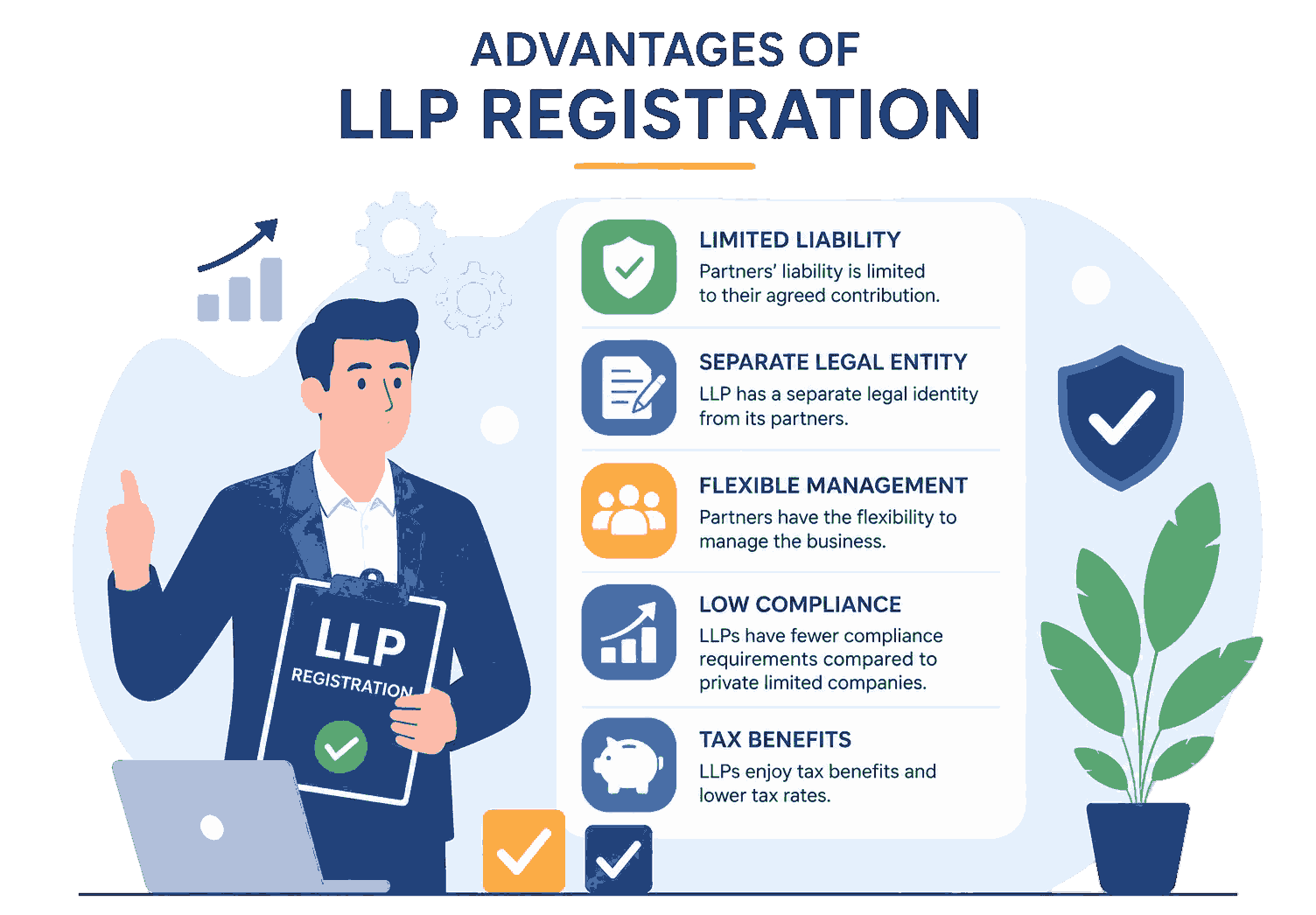

Business Liability:
Personal assets stay protected. Business liabilities do not extend to the personal assets of partners.

Minimal Capital:
Starting capital can be as low as Rs 1. This is one of the real advantages of LLP registration.

Simpler Compliance:
Fewer filings and fewer rules compared to running a Private Limited Company

Separate Legal Entity:
LLP is a separate legal entity that signs contracts and holds assets in its own name.

Tax-efficient Profits:
Partners receive their share of profits without any deduction towards Dividend Distribution Tax.

Limited Partner Liability:
Why choose LLP over a partnership firm: the misconduct of one partner does not create liability for the others.
Disadvantages
Disadvantages of LLP Registration in India
An LLP is not the right choice for every business. Before LLP Registration, consider some important disadvantages.
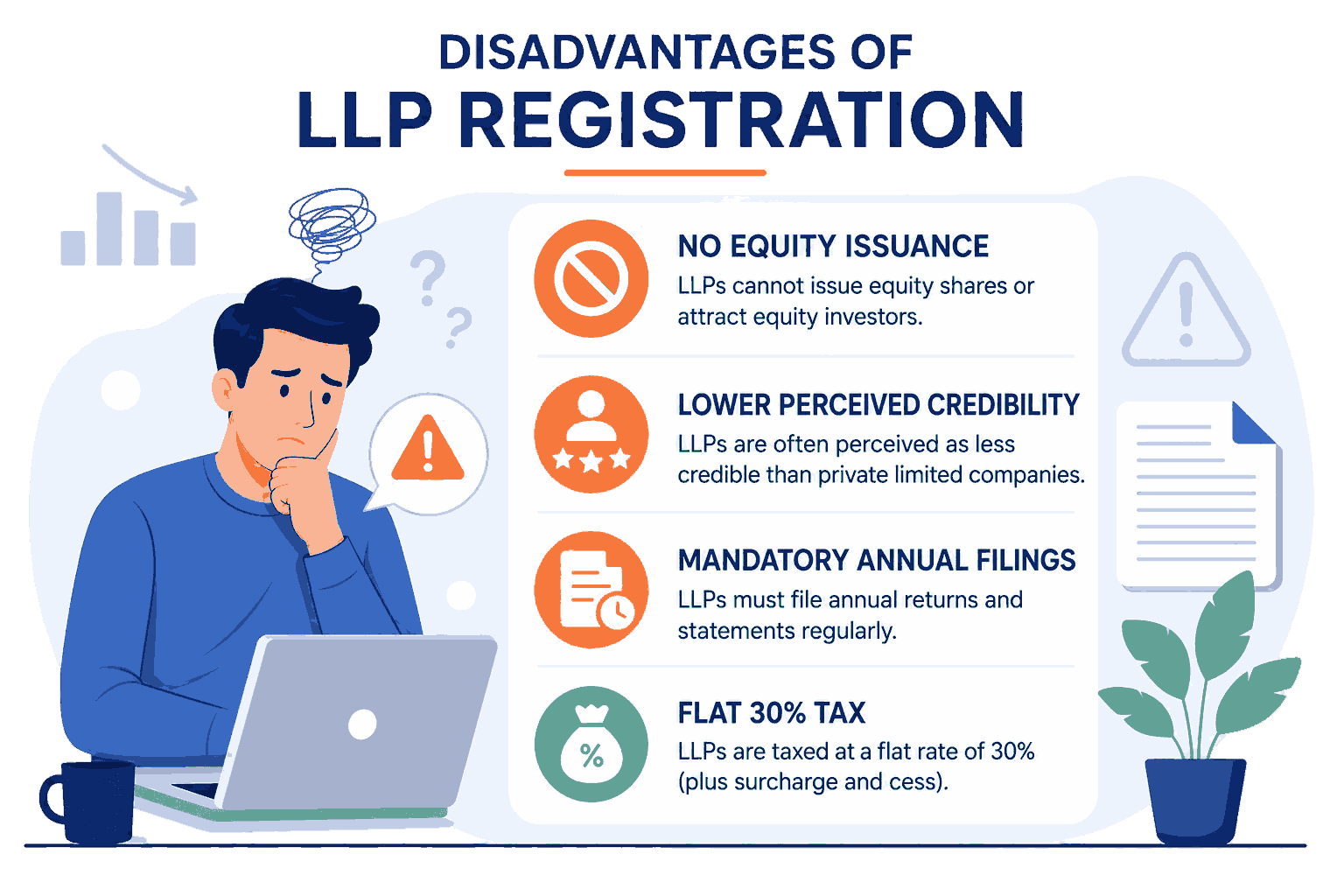

No Equity Issuance
The shares cannot be issued. Equity investors and venture capitalists typically avoid this structure.

Lower Perceived Credibility
Large clients and banks still tend to favour a Pvt Ltd company over an LLP.

Mandatory Annual Filings
Mandatory annual filings apply even with zero turnover or activity.

Flat 30% Tax
Profit tax remains the same at 30%, no matter how small the LLP is.

Complex Dissolution
Closing an LLP is a proper MCA process, but it's not a quick process.

Foreign Investment Restrictions
It's difficult to attract foreign investors. This is a structural limitation of LLPs that should be addressed.
DOCUMENTS REQUIRED
Documents Required For LLP Registration
Before you begin, please check this LLP registration documents checklist. Missing even one document will result in the MCA returning your application, and you will waste days waiting-


Partners Documents
- PAN Card - This is the primary document the MCA verifies. Every document submitted must carry the same name as on the PAN.
- Aadhaar Card - Along with a recent passport-size photograph.
- Address Proof - Voter ID works, so does a Driving Licence or a utility bill not older than 2 months.
- DSC (Digital Signature Certificate) - Each Designated Partner needs a Class 3 DSC before any form can be signed online.
- DPIN (Designated Partner Identification Number) - Filed directly inside the FiLLiP form. No separate application needed.
Foreigners and NRI Documents
- Passport - Must be notarised and apostilled. Overseas address proof needs the same treatment.
- PAN Card - Indian PAN if already issued, or Form 49AA to apply for one.
- DSC - Issued by a certifying authority that India recognises.
Registered Office Address Proof Documents
- Owned Property - Sale deed along with a current utility bill.
- Rented Property - Rent agreement, utility bill, and a written NOC from the property owner.
LLP Agreement Draft
- LLP Agreement - Written agreement covering profit split, roles, and capital contribution. Notarised on stamp paper. Every partner signs off on it.
- Form 3 Filing - Submitted to MCA within 30 days of incorporation. Missing this deadline costs Rs. 100 per day.
Not sure if your partner KYC documents or registered office proofs meet MCA standards? Check our Complete Document Checklist for LLP Registration to ensure a smooth, error-free filing.
ELIGIBILITY
Who is Eligible For LLP Registration In India?
The LLP Act 2008 decides who gets to form an LLP and who does not. Review these conditions before beginning your application on the MCA portal.
Who Can Register an LLP in India:
|
|
|
|
|
|
|
|
|
|
|
|
|
|
|
|
|
|
|
|
|
|
|
|
|
PROCEDURE
LLP Registration Process in India
For LLP Company Registration Online, you need to navigate through the following key steps.
1. Get a Digital Signature Certificate:
Every designated partner of the LLP must apply for and obtain a Digital Signature Certificate (DSC) because it is mandatory for all kinds of government filings.
2. Obtain the Designated Partner Identification Number:
All the partners need to apply for the Designated Partner Identification Number (DPIN). It is a unique identification number provided to individuals longing to become designated partners of LLPs.
3. Select a Name for the LLP:
Partners need to pick a unique name for the LLP. The name should not be copied, and should adhere to the guidelines of the Ministry of Corporate Affairs.
4. Fill out the Incorporation Form (FiLLiP):
FiLLiP is the form to collect the necessary information for the registration of the proposed LLP and its partners. It also requires partners to sign a declaration indicating they will comply with LLP regulations.
5. Create an LLP Agreement:
Partners must create an LLP agreement that mentions their duties, rights, and obligations. This agreement needs to be notarized and submitted to the Ministry of Corporate Affairs within 30 days of LLP incorporation.
6. Obtain a Certificate of Incorporation:
On the completion of filing and verification of documents, the Registrar of Corporations (ROC) issues the Certificate of Registration. It officially acknowledges that the LLP exists. PAN and TAN will also be there on the COI.

Is Your Business Name Taken? Find Out Instantly
Your LLP Company name is more than a label; it's your brand's first impression. Before you fall in love with a name, make sure it's legally yours to claim. Want to skip the guesswork? Our Company Name Search service helps you identify compliant, available names with expert guidance: from first search to final approval.
Fees
LLP Registration Fees in India
|
|
|
|
|
|
|
|
|
|
|
|
|
|
|
|
|
|
|
|
|
|
|
|
|
|
|
|
|
|
|
|
|
|
|
|
|
|
|
|
Stamp Duty on LLP Agreement:
Each state sets its own rate, typically ranging from 0.1% to 2% of the capital contribution amount. Delhi, Maharashtra, and Karnataka each have separate slabs. Your Chartered Accountant will confirm the applicable rate before the agreement is finalised.
DSC Charges:
Budget approximately Rs. 1,200 to Rs. 2,000 per designated partner. Depends on validity chosen and the certifying authority.
Professional Fees:
Document work, LLP agreement drafting, portal filing, and following up with the MCA until the Certificate of Incorporation is issued.
One Cost is Frequently Overlooked:
Form 3 late filing penalty. It’s ₹100 per day, no upper limit, and it begins the day after that 30-day window for incorporation ends. Now, the overall cost for LLP registration in 2026 can end up different, but yeah, this kind of late penalty by itself could also go beyond the government fees.
Timeline
How Long Does LLP Registration Take?
In India, LLP registration usually takes around 10 to 20 working days, counting from the date when the documents are filed. The step by step timeline is sort of given below, so you can see how it goes-
|
A rejected name extends the incorporation timeline by at least 2 to 4 days, as do errors in the submitted documents. Where partners are located in different cities, the notarisation stage tends to take longer than anticipated. Thirty days from the incorporation date is when Form 3 is due. Beyond this point, a penalty of Rs. 100 per day applies, an aspect of the process many applicants become aware of only after the deadline has passed. |
DSC Procurement
All designated partners of the LLP are required to obtain the Class 3 Digital Signature Certificate (DSC).
Timeline: It takes generally 1-2 days, issued by CAs (licensed certifying authorities).
Name Reservation LLiP
The proposed name is checked against MCA's database and reserved. Reserve the LLP name by using the FilLLiP, which offers an integrated, all-in-one process.
Timeline: The name approval process completes within 1-3 days.
Certificate of Incorporation (FiLLiP)
Once all the documents and application details are verified by the ROC (Registrar of Companies), the LLP receives the CoI.
Timeline: The procedure takes 5-7 days.
LLP Agreement Drafting
"LLP Agreement," which highlights the rights, duties, and profit sharing between partners, must be filed with the MCA.
Timeline: Must be drafted within 30 days of receiving COI.
PAN and TAN Issuance
PAN and TAN are automatically generated shortly after issuing the Certificate of Incorporation. The e-PAN is issued immediately on the registered email ID.
Timeline: Takes 10-15 days to get a physical PAN card and TAN letter.
Post Incorporation
Post Incorporation Checklist for LLP Registration
Once the Certificate of Incorporation is issued, the following steps must be completed without delay.
Form 3: LLP Agreement Filing
30 days from incorporation date
Form 11: LLP Annual Return
30 May each year
Form 8: Statement of Account and Solvency
30 October each year
Income Tax Return
31 July or 30 September if audit needed
Accounts Audit
Crosses Rs. 40 lakh turnover or Rs. 25 lakh capital
GST Return Filings
Monthly or quarterly, per your scheme
Post-registration compliance is mandatory. Both Form 8 and Form 11, which constitute the annual filings for an LLP in India, attract a daily penalty for delay, and this penalty continues to accrue until the form is actually submitted. JustStart's compliance team files ahead of each due date rather than after it.
Annual Compliance
Annual Filings for Limited Liability Partnership (LLP)
Financial Statements
Every LLP is required to prepare and file financial statements on an annual basis. The financial statements consist of:
- Statement of Accounts: Includes the Balance Sheet, Profit and Loss Account, and Cash Flow Statement.
- Statement of Solvency: This statement is obligatory only for LLPs that have a turnover of over ₹40 lakhs or a capital contribution of above ₹25 lakhs.
Annual Returns
The annual returns are to be filed by the LLPs with the Registrar of Companies (ROC). The annual return consists of information such as:
- Statement of Account: It is filed with the ROC within 30 days after the end of the six-month period from the financial year.
- Annual Return Form: It is filed within 60 days after the end of the financial year.
Audit Requirements (if any)
The audit requirements for LLPs depend on the amount of their turnover and capital contribution:
- Audit Requirement: LLPs with a turnover exceeding ₹40 lakhs or capital contribution beyond ₹25 lakhs are required to have their accounts audited by a Chartered Accountant.
- Exemption: Small LLPs (ones whose turnover does not exceed ₹40 lakhs and whose capital contribution is limited to ₹25 lakhs) are not required to undergo auditing.
_1767772841.gif)
Why JustStart?
Why JustStart For LLP Registration?
Choosing JustStart for your LLP Registration means entrusting the process to reliable and experienced hands. Our team comprises experts well-versed in the intricacies of LLP registration in India, providing dedicated guidance from initiation to completion. Here are compelling reasons to opt for our services.
✔ Seamless Process Handling: Efficiently manages the entire registration process for you.
✔ Transparent Communication: Keeps you informed every step of the way.
✔ Google-verified Business: Trusted and verified, providing added credibility.
✔ End-to-End Support: Offers support from initial inquiry to final registration.
✔ Stress-Free Process: Simplifies steps to reduce stress and complexity.
✔ Regulatory Compliance: Ensures all legal and regulatory requirements are met.
✔ Time-Efficient Services: Completes the registration process promptly and efficiently.

Register your LLP and enjoy the benefits of a flexible business structure backed by limited liability protection.
Contact UsLocations
LLP Registration in Other States and Cities
FAQs
LET'S CLEAR ALL THE DOUBTS!
LLP Registration in India is a legal entity that blends partnership advantages with limited liability, similar to corporations. Registration with the Ministry of Corporate Affairs (MCA) is mandatory, ensuring partners are protected from personal liability beyond their investments.
Registering an LLP in India typically costs between INR 7,000 to INR 15,000. This covers fees for reserving a name, getting the LLP officially recognized, and getting help with paperwork. Prices can change based on how much money the partners put in and how complicated the process is.
Yes, you can register an LLP (Limited Liability Partnership) yourself in India. Prefer to use professional services to ensure compliance and smooth process.
There is no requirement for a minimum capital contribution in an LLP. You can start with an amount that suits your business size and needs.
An LLP Company should pay a 30% fixed rate tax on its total income.
For LLP Company Registration in India, you need identity and address proofs (such as PAN card or passport, Aadhaar card), proof of office address, NOC from the landlord, DSC and DIN for partners, LLP agreement, and consent letters from partners.
The LLP Registration Process in India involves obtaining Digital Signatures Certificates (DSC) and Director Identification Numbers (DIN) for partners, applying for name reservation, filing incorporation documents, and submitting the LLP Agreement with the Ministry of Corporate Affairs (MCA Portal) online.
An LLP in India needs GST registration if its turnover exceeds the threshold limit or if it sells taxable goods or services.
The benefits of LLP Registration include protecting personal belongings from business debts through limited liability. It offers the flexibility of a partnership along with the safety of limited liability.
Yes, both NRIs (Non-Resident Indians) and foreign nationals can be partners in a Limited Liability Partnership (LLP) in India. However, at least one Designated Partner must be a resident of India to comply with the LLP Act, 2008.
Click here to read more about Company Registration for Foreigners & NRIs
Yes, a registered office address in India is mandatory to incorporate an LLP. The office can be either commercial or residential, but it must be a valid location where government communications and legal notices can be received, for example, a Virtual Office Address.
Yes, Foreign Direct Investment (FDI) is permitted in LLPs under the automatic route, but only in sectors where 100% FDI is allowed, and there are no performance-linked conditions. In restricted sectors, prior approval from the government is required before investing.
Stamp Duty on LLP Agreement is a tax imposed by the various state governments on legal documents to have them either made legal or to be able to use them in court. The main document in the LLP registration procedure that incurs stamp duty is the LLP agreement.