

ROC Return Filing for One Person Company | File AOC-4 & MGT-7A
OPC annual filing means submitting Form AOC-4 and Form MGT-7A to the ROC every year, reporting your company's finances and ownership information without the need for an AGM, which other companies face. JustStart prepares your audited financial statements, handles auditor appointments through Form ADT-1, and files everything on time, keeping solo entrepreneurs compliant under the Companies Act, 2013.
- Sept 27 - AOC-4 Deadline
- Oct 14 - ADT-1 Auditor Filing
- No AGM Required
- Simpler Compliance Than Pvt Ltd
- Single Director Filing Process
EVERYTHING INCLUDED IN YOUR OPC ANNUAL FILING PACKAGE
- Financial Statement Preparation
- Audit Coordination (If Applicable)
- Board Resolution & Minute Book Entry
- Form AOC-4 Preparation & Filing
- Form MGT-7A Preparation & Filing
- Form ADT-1 Auditor Appointment Filing
- Filing Status Tracking & Record
Request a Callback

4.9 star all time rating

4.8 star all time rating
OVERVIEW
What is ROC Compliance for OPC Company?
The annual filing of a One Person Company (OPC) includes financial statements that have been audited and are prepared in accordance with the regulations using Form AOC-4, along with the annual returns through Form MGT-7A. Form AOC-4 is filed within 180 days from the end of the financial year, which in this case falls on September 27, 2026. Whereas the Form MGT-7A is filed within 60 days after the date of the signed financial statements, usually between November 26th and 28th each year for a March 31 financial year-end. Under Section 122, a One Person Company (OPC) is exempt from holding the Annual General Meeting (AGM) but instead keeps a record of the approvals in the minute books, which acts as the deemed AGM date.
The OPC is required to file the Form ADT-1 upon the appointment of a Statutory Auditor and is required to file within 15 days with the ROC (Registrar of Companies). Maintaining the OPC's annual compliance is crucial to meet all legal obligations set by the MCA (Ministry of Corporate Affairs). On-time annual return filing protects from strike-off, avoids director disqualification, and maintains the overall OPC's activities. Failure to meet the OPC company annual compliance results in a mandatory late fee of ₹100 per form/per day with no maximum cap. Maintaining the annual compliance formalities is not only important to operate a One Person Company lawfully but also to safeguard from the possible strict MCA penalties.

Required Forms
Forms Required for OPC Annual Return Filing
An OPC (One Person Company) is required to submit its financial activities to the Registrar of Companies (ROC) on the MCA V3 portal. The ROC annual filing is legally mandatory to maintain and file the annual forms regardless of business activity or zero turnover. These are the core OPC annual compliance forms that must be filed before the deadline:An OPC (One Person Company) is required to submit its financial activities to the Registrar of Companies (ROC) on the MCA V3 portal. The ROC annual filing is legally mandatory to maintain and file the annual forms regardless of business activity or zero turnover. These are the core OPC annual compliance forms that must be filed before the deadline:

✅ Form AOC-4 (Financial Statements)
An OPC is required to file audited financial statements via Form AOC-4. This annual statement must be filed within 180 days from the close of the financial year (usually September 27 each year). The main details that OPC asks for to prepare while filing the form are the Balance Sheet & Profit & Loss Account, auditor’s report, board’s/Director’s report, and notes to accounts
✅ Form MGT-7A (Simplified Annual Return)
The OPCs are required to file this simplified annual return form, mandatory under Section 92 of the Companies Act, 2013. It simply covers non-financial and governance details such as registered office records, directors' details, business activities, details of shareholder/nominee, etc. An OPC is generally exempted from holding the AGM (Annual General Meeting). Therefore, the due date of filing MGT-7A is 60 days from the deemed AGM date (Usually falls filing date on November 27/28 each year).
✅ Form ADT-1 (Appointment of Statutory Auditor)
Filing Form ADT-1 is mandatory for the One Person Company (OPC) under Section 39(1) of the Companies Act, 2013, when it appoints a statutory auditor. The sole director of the OPC is first required to pass the Board Resolution within 30 days of appointing the first auditor. Form ADT-1 must be filed by the OPC within 15 days of the appointment of the auditor.
✅ Form DIR-3 KYC (Director KYC Verification)
The sole director holding the DIN (Director Identification Number) is required to file Form DIR-3 on the MCA portal to keep it active. However, the MCA changed the old filing process to a 3-year compliance cycle. This means the Form DIR-3 KYC must be filed once every three years on or before 30 June. But if any changes occur to an OPC's directors, address, or any details, the updated DIR-3 KYC web form must be submitted within 30 days of the changes on the MCA V3 portal.
✅ DPT-3 (Annual Return)
Under the Companies (Acceptance of Deposits) Rules, 2014, a legally registered OPC (One Person Company) is also required to file Form DPT-3 if it meets the set reporting criteria. Filing the DPT-3 is mandatory for an OPC in the following conditions: when it has outstanding loans, loans received from the director, or advances from the customers. Further, the OPC must file the DPT-3 on or before June 30 of the financial year. Filing Form DPT-3 is not required if the OPC has no/zero outstanding loans or non-deposit receipts as of March 31; instead, file the Nil Return.
Importance
Why Is OPC Annual Filing So Important?
A lot of OPC proprietors have a misconception that since there is just one owner and the company is small, compliance would not be necessary. This is a wrong assumption. The OPC Annual Filing done in time and correctly is very important because it:
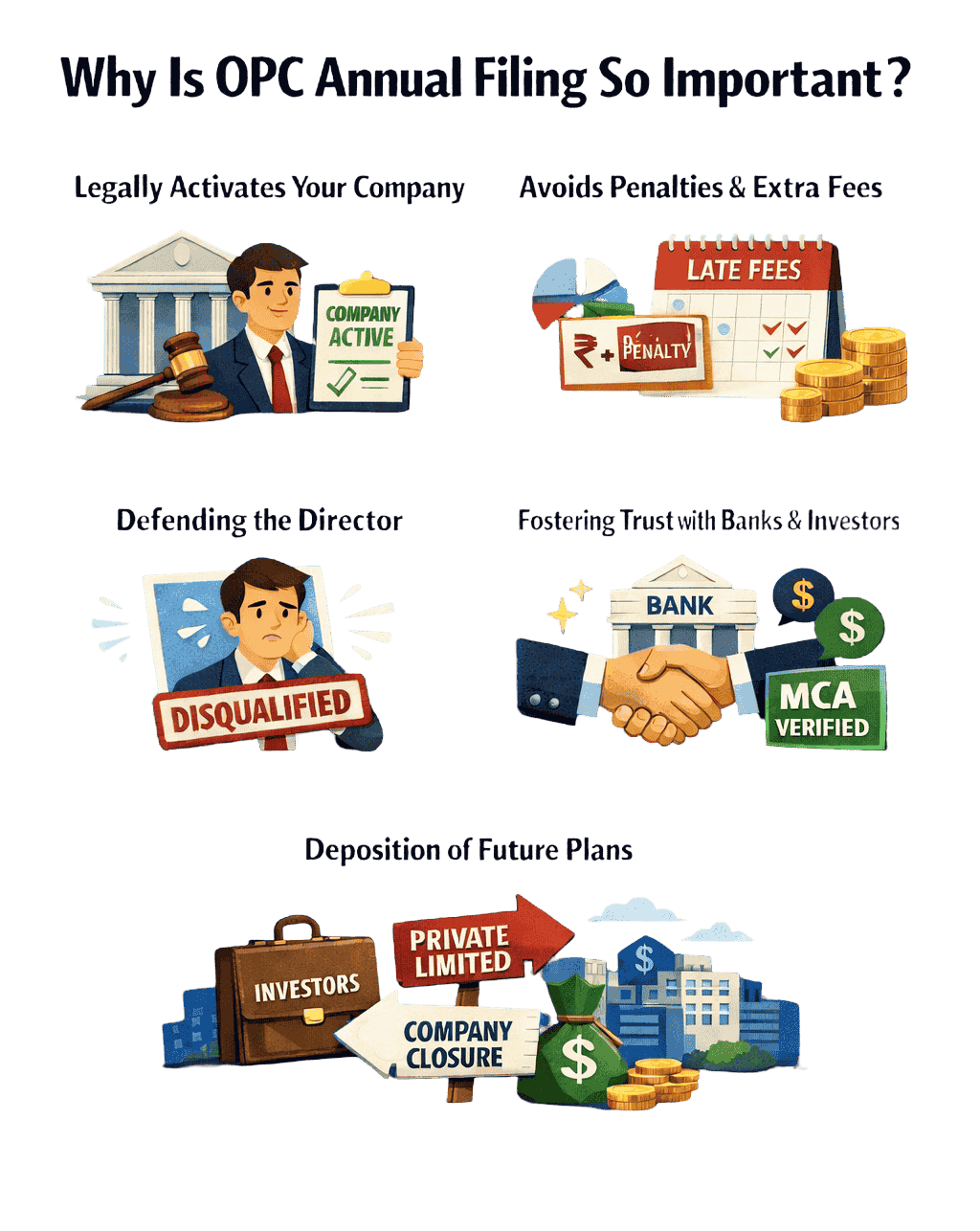

Legally Activates your Company
ROC filings are compulsory for every OPC that is active. Not filing can finally result in the company being declared as defaulting or even taken off the register.
Avoids Penalties and Extra Fees
Filing one’s return late incurs heavy extra fees that are calculated per day of delay. Over time, the total amount can be much more than the actual government filing fee.
Defending the Director Against Disqualification
Consistent non-compliance may lead to the director being disqualified for directorship in other companies.
Fostering Trust with Banks, Investors, and Clients
A number of lenders and corporate clients verify your records through the MCA portal. Clean compliance gives your OPC a trustworthy and professional appearance.
Deposition of Future Plans without Trouble
Be it the case of transforming the OPC into a private limited company, getting investors, or legally closing the company, a compliance history of good standing makes the process quicker and smoother.
Documents Required
Documents Required for OPC Annual Filing
A professional service provider will lend you a hand with a concise list of requirements; however, you should, in general, have the following items on hand for the proper compliance of One Person Company:
Documents Required for AOC-4
- Audited Balance Sheet signed by the OPC director & scrutinized by the statutory auditor
- Profit and Loss Account for the financial year
- Statutory Auditor’s Report issued by an Independent practising CA
- Notes to Accounts accompanying the financial statements
- Director’s report signed by the sole director
- Minutes of the Board approving the financial statements
Documents Required for MGT-7A
- Capital structure and shareholding details
- Director and nominee’s updated address, identity and DIN details
- Corporate Identification Number (CIN) and PAN
- Proof of registered office details with Email and contact number
- Balance Sheet and Profit & Loss Account data
- Auditor’s report (only if turnover exceeds ₹2 crore or paid-up capital exceeds ₹25 lakh)
Additional Documents Required
- Valid Class 3 DSC (Digital Signature Certificate) for e-filing
- Form ADT-1 (SRN required)
- Form DPT-3 supporting files
- Bank Statements & trial balance
Process
Step-by-Step Guide For OPC Annual Filing Process
These few comprehensive procedures help to make the OPC annual filing faster and error-free. Follow these core steps to file the annual compliance on the MCA V3 portal, focusing on your OPC growth. The process is as follows:
Finalise Books of Accounts
Indian companies, including OPCs, are required to maintain true and fair books of account, as mandated under Section 128 of the Companies Act, 2013. Once the books of account are completed, you have to check if all the details match the bank statements, invoices (physical or digital), and the GST reconciliation.
Statutory audit by Chartered Accountant
Under Section 143 of the Companies Act, 2013, companies are required to appoint a verified practicing Chartered Accountant (CA). All details such as financial statements, bank statements, and books of accounts are audited by a CA. After the audit, the CA issues an independent Auditor’s report.
Draft Annual Compliance Forms & Director’s Report
Under Section 143(3) of the Companies Act, 2013, the companies are required to prepare the Director’s report. Once prepared, required to file all OPC annual compliance documents like AOC-4, MGT-7A, and DIR-3 KYC. Must ensure you file all annual compliance forms before or on their due date; otherwise, it triggers late filing charges.
Sign Form via Class 3 DSC
The sole director of the OPC must have a Class 3 DSC. Before signing documents digitally, you must ensure that the DSC is active and not expired; otherwise, it can create an error during processing.
Upload Forms & Make Payment
The OPC annual compliance forms like AOC-4, MGT-7A, etc, must be uploaded on the MCA V3 portal. Must ensure you first file the AOC-4 before filing the MGT-7A. To pay the government fees on the MCA V3 portal, use any payment mode (like netbanking, UPI, Credit/Debit card).
Receive the SRN (Service Request Number)
Once all annual forms are filed and the payment is made, the portal generates an SRN (Service Request Number). You can use the SRN to track the status of annual filing on the MCA V3 portal.
OPC vs Pvt Ltd
OPC vs Private Limited – ROC Filing at a Glance
A lot of solo entrepreneurs prefer to establish a One Person Company (OPC) since it is less complex than a complete private limited company structure. However, the ROC filing is still a bit less burdensome than before.
|
Aspect |
One Person Company |
Private Limited Company |
|
AGM Requirement |
No AGM required; deemed AGM concept applies. |
AGM is mandatory each year. |
|
Financial Statement Form |
AOC-4 (OPC-specific timelines) |
AOC-4 within 30 days of AGM. |
|
Annual Return Form |
MGT-7A (for OPC and small company) |
MGT-7 (standard annual return). |
|
Due Date Logic |
180 days from FY end for AOC-4; 60 days for MGT-7A. |
30 days (AOC-4) and 60 days (MGT-7) from AGM date. |
|
Compliance Burden |
Comparatively simpler, fewer meetings and lighter reporting. |
Higher, more corporate governance and reporting formalities. |
|
Aspect |
One Person Company |
|
|
AGM Requirement |
|
|
|
|
|
|
|
|
|
|
|
|
|
|
|
|
|
|
Despite these easements, the yearly ROC filing for OPC remains compulsory and unalterable.
Penalties
Penalties and Consequences of Late or Non-Filing
The failure to comply with the ROC Annual Filing for OPC will have serious consequences. The main risks are as follows:
 (1)_1768290279.png)

Heavy Additional Fees
Forms like AOC-4 and MGT-7A with ROC are subject to very high extra costs per day of delay when the due date is not met. This can lead to a huge financial burden if calculated over months or years. The late fee will be ₹100 per day and per form, till the filing of AOC-4 and MGT-7A; moreover, additional monetary penalties and risk of prosecution in very rare situations under Sections 92 and 137.

Statutory Penalties
Moreover, to additional fees, there can also be statutory penalties imposed on the three parties involved the company (OPC), the officer in default (which is usually the director) and the amount of the penalties may depend on the nature and extent of the default, and they may be charged in addition to late filing fees.

Director Disqualification
In case there is a long-lasting non-compliance in the director's situation, he or she will be ranked as disqualified for a certain period of time and not be allowed to take up posts in other companies. This would have a huge impact on the company's future business plans.

Defaulting or Dormant Status
An OPC that does not file its Annual Return in time will be marked as non-compliant or defaulting on the MCA portal. It is like a badge of dishonour, and it will hurt the company's reputation with:
- Banks
- Vendors and customers
- Potential investors or partners

Strike-Off of the Company
In non-filing that lasts long and is serious, the ROC may take action to remove the company's name from the register. Although this may sound like stopping the operation, it may take place in an undesired or even harmful way for the promoter, and it could also lead to more complications.
|
OPC Annual Filing Form |
Government Fees |
Professional fees |
|
Form AOC-4 |
Ranges from ₹200 to ₹600 (depends on nominal (authorized) share capital |
₹2,000-₹4,000 |
|
Form MGT-7A |
Ranges from ₹200 to ₹600 (depends on nominal (authorized) share capital |
₹1500-₹3000 |
|
Form ADT-1 |
₹200 to ₹600 (depends on nominal (authorized) share capital) |
₹1500-₹2000 |
|
Form DIR-3 KYC |
Free on MCA V3 Portal |
₹1000-₹2000 (per director) |
|
OPC Annual Filing Form |
Government Fees |
Professional fees |
|
Form AOC-4 |
Ranges from ₹200 to ₹600 (depends on nominal (authorized) share capital |
₹2,000-₹4,000 |
|
Form MGT-7A |
Ranges from ₹200 to ₹600 (depends on nominal (authorized) share capital |
₹1500-₹3000 |
|
Form ADT-1 |
₹200 to ₹600 (depends on nominal (authorized) share capital) |
₹1500-₹2000 |
|
Form DIR-3 KYC |
Free on MCA V3 Portal |
₹1000-₹2000 (per director) |
Filing with the ROC for an OPC in a timely manner has always been more cost-effective and safer than dealing with penalties and legal issues that might accumulate later on.
Fees
Government Fees Vs. Professional Fees for OPC Annual Compliance Filing
Government fees for OPC annual compliance vary by form. The exact fees depend on the specific form that you are filing. Whereas the professional fee also varies by the services. Check out the table to see the costs of professional and government fees for OPC annual compliance.
|
|
|
|
|
Form AOC-4 |
Ranges from ₹200 to ₹600 (depends on nominal (authorized) share capital |
₹2,000-₹4,000 |
|
Form MGT-7A |
Ranges from ₹200 to ₹600 (depends on nominal (authorized) share capital |
₹1500-₹3000 |
|
Form ADT-1 |
₹200 to ₹600 (depends on nominal (authorized) share capital) |
₹1500-₹2000 |
|
Form DIR-3 KYC |
Free on MCA V3 Portal |
₹1000-₹2000 (per director) |
The exact professional fee depends on the specific service operator (agency) and the annual filing difficulty. Beyond government fees, you are usually required to pay additional charges if missed the initial filing deadline.
Why Choose JustStart?
Why Choose JustStart for OPC Annual Return Filing?
At JustStart, we provide effective legal solutions to ensure ROC compliance for One Person Companies (OPC) in India.

Our team of legal experts offers guidance, ensuring your annual return filing is timely and accurate.
✅ Experienced Legal Consultants
Our experienced legal consultants guide you through the intricacies of OPC filing requirements, ensuring you meet all regulatory deadlines.
✅ Hassle-Free Filing Process
We simplify the OPC annual return filing process, saving you time and effort while ensuring compliance.
✅ Timely and Accurate Submissions
We ensure that all forms are filed on time, avoiding penalties and keeping your OPC in good standing with the Registrar of Companies.
✅ Comprehensive Legal Support
Our team provides ongoing support, answering all your questions and offering expert advice on OPC compliance and filing requirements.
✅ Cost-Effective Solutions
We offer affordable services, providing high-quality legal assistance at competitive prices to ensure you stay compliant without breaking the bank.
Locations
Annual Filing For OPC in Other States and Cities
FAQs
LET'S CLEAR ALL THE DOUBTS!
Annual compliance requirements for a One Person Company (OPC) include submitting annual returns, financial statements, and tax returns. Additionally, the OPC must hold an Annual General Meeting (AGM) within six months after the end of the financial year.
-
Form AOC 4: Contains financial details like the profit & loss account, balance sheet, and compliance certificate.
-
Form MGT 7: Provides information on the OPC’s shareholding structure, directorship changes, and share transfers.
-
Form ADT 1: Used for the appointment of an auditor; must be filed by 14th October each year.
No, an OPC is exempt from holding the Annual General Meeting (AGM), as described under Section 96 of the Companies Act, 2013. Instead, the sole director of the OPC maintains the approval of the financial statement and the auditor’s appointment in the company’s minute books.
Delays in filing can result in a penalty of ₹100 per day until the filing is completed, with no maximum limit. Continuous non-compliance may lead to additional penalties, including fines and imprisonment for both the company and its directors.
The government fees for annual compliance of an OPC typically range from INR 1500 to 2500. Any applicable penalties will be charged in addition to these fees.
No, as per the MCA rules, an OPC (One Person Company) cannot file the MGT-7 as it is only applicable for larger private and public companies. Instead, an OPC is required to file the simplified form MGT-7A.
Yes, all registered companies, including an OPC, are required to have their financial books audited by a practicing Chartered Accountant (CA) as mandated under the Companies Act, 2013. The statutory audit is mandatory regardless of business activity and turnover in the preceding financial year.
Failing to file the AOC-4 before the due date triggers late filing. The MCA charges an additional late filing fee of ₹100 per day with no upper cap. For example, if you delay filing the AOC-4 for 160 days, then you need to pay the late filing charges of ₹16,000.
Yes, a dormant or zero-transaction One Person Company (OPC) is still required to file the annual returns with the Ministry of Corporate Affairs (MCA), even with zero business activity.
The standard government filing fee for the MGT-7A on the MCA (Ministry of Corporate Affairs) ranges from ₹200 to ₹600. The exact cost depends on the company’s nominal share capital. Even if there is no share capital, you are required to pay ₹200.