

Foreign Direct Investment (FDI) Compliance & Advisory Services in India
Foreign Direct Investment (FDI) is when a company, person, or government from another country invests in businesses or projects in India. India is marked as one of the top global destinations for FDI among emerging economies, consistently attracting significant foreign capital. Make your journey more seamless with JustStart, as we simplify foreign direct investment (FDI) into India by managing foreign subsidiary incorporation, bank setups, and annual filing formalities.
- 30 Days for Automatic Route
- 12 Weeks for Government Route
- NSWS Portal Filing
- Form FC-GPR Filing
- FDI Approval Letter
Everything included in your Foreign Direct investment package
- Automatic & Government Route Eligibility Check
- Foreign Equity Guidance (FDI sectoral cap)
- Assistance to Submit Application on FIFP
- FC-GPR/FC-TRS Filing Support
- Ongoing FEMA & RBI Compliance
- FLA Return Filing Yearly
- 100% Online & Paperless Process
Request a Callback

4.9 star all time rating

4.8 star all time rating
OVERVIEW
What is Foreign Direct Investment (FDI)?
Foreign Direct Investment (FDI) is a process under which non-residents, such as foreign individuals or entities, invest in Indian businesses to establish a lasting interest. The major intent of a non-resident entity or company is to gain a lasting interest and participate in the management and control of the Indian business. International individuals or businesses generally obtain substantial shareholder rights by acquiring 10% or more of an Indian company's equity. In India, FDI is primarily governed by the Foreign Exchange Management Act, 1999 (FEMA), the NDI Rules (Non-Debt Instruments Rules, 2019), and the annually updated Consolidated FDI Policy. Meanwhile, these frameworks are administered by the RBI (Reserve Bank of India) and DPIIT.
Under the RBI and FEMA guidelines, the foreign investments are categorized as FDI that holds 10% or more equity, which is committed to long-term investment. This 10% is a classification threshold, not a compulsory minimum for every international investment. FDI in India directly impacts economic growth, boosts employment, brings advanced technology, helps to improve labour skills, and enhances foreign exchange reserves. Most foreign sectors don't require government approval, as FDI is often permitted under the “Automatic Route." Foreign individuals or companies only need to notify the RBI (Reserve Bank of India) after funds are received and shares are issued.
FDI vs FPI vs ODI
Comparison Between FDI vs FPI vs ODI?
FDI and FPI are both inbound investments. FDI is typically made by companies or strategic investors, while FPI is usually made by institutional or individual investors through financial markets. Whereas Overseas Direct Investment (ODI) is an outbound investment for a domestic Indian enterprise or an Individual. The key difference at a glance:
| Features | FDI (Foreign Direct Investment) | FPI (Foreign Portfolio Investment) | ODI (Overseas Direct Investment) |
|---|---|---|---|
| Direction | Inbound (foreign to host country) | Inbound (foreign to host country) | Outbound (domestic to foreign markets) |
| Initial Purpose | Expand business franchises and direct business operations. | Financial returns from market price movements. | Expand a domestic entity internationally. |
| Ownership & Control | Management control (usually more than 10% of voting stock). | No active management or operational control. | Complete control through joint ventures and subsidiaries. |
| Holding Period | Long-term | Short-to-medium term | Long-term |
| Asset Type | Real estate, physical assets, and company equity. | Financial securities, including stocks, bonds, and ETFs. | Foreign entities, branches, and joint ventures. |
| Liquidity | Long-term and less liquid; harder to exit quickly. | Securities can be sold quickly in the market. | Long-term overseas business commitments. |
| Governing Body (in India) | DPIIT, Government of India, and RBI. | Governed by SEBI and RBI. | Regulated by the RBI under FEMA. |
The table provides a high-level comparison of common investment characteristics. Regulatory requirements may vary by transaction and applicable law.
ELIGIBILITY
Who Can Invest - Eligible Investors & Entity Structure
In some cases, no prior government approval is required for investment in Indian companies or LLPs, and the process can be done via an Automatic Route. However, the eligible applicants under the FDI rules in India are:
Eligible Applicants
- NRIs and PIOs are also eligible to invest in shares and convertible debentures.
- The foreign entities that hold the status of Foreign Portfolio Investors (FPIs).
- The foreign entities, individuals, and corporate bodies, including trusts. (Reside Outside of India).
- The countries that share a land border with India, such as China, Pakistan, and Bangladesh, require prior government approval.
Eligible Entity Structure
The international investors can invest in or fund various Indian entities. These major eligible entities include:
Private Limited Companies: This business structure is ideal for those investors who are looking for long-term operational benefits with manufacturing and general business.
Limited Liability Partnership (LLP): FDI in LLPs is permitted under the Automatic Route in sectors where 100% FDI is allowed under the Automatic Route, and there are no FDI-linked performance conditions.
Branches, Offices/Liaison Offices: Chosen by those foreign entities who desire to establish a presence, conduct research, or act as a representative office.

Prohibited Sectors
In a few sectors, FDI is completely restricted regardless of the investors' or companies' structures. These prohibited sectors are gambling, betting, and casinos, including the lottery business; chit funds; nidhi companies; TDRs; and the manufacturing of cigars, cigarettes, and tobacco products. FDI is not permitted in the “real estate business” (such as trading in land or immovable property for profit) but is allowed in certain construction-development projects, such as townships and built-up infrastructure, subject to applicable conditions.
Framework
Land-Border Country (LBC) Framework
The FDI (Foreign Direct Investment) guidelines relating to investors from countries sharing land borders with India are set out in the relevant press notes and the Foreign Exchange Management (Non-Debt Instruments) Rules, 2019, as amended from time to time. The framework aims to balance ease of investment with national security and regulatory oversight.
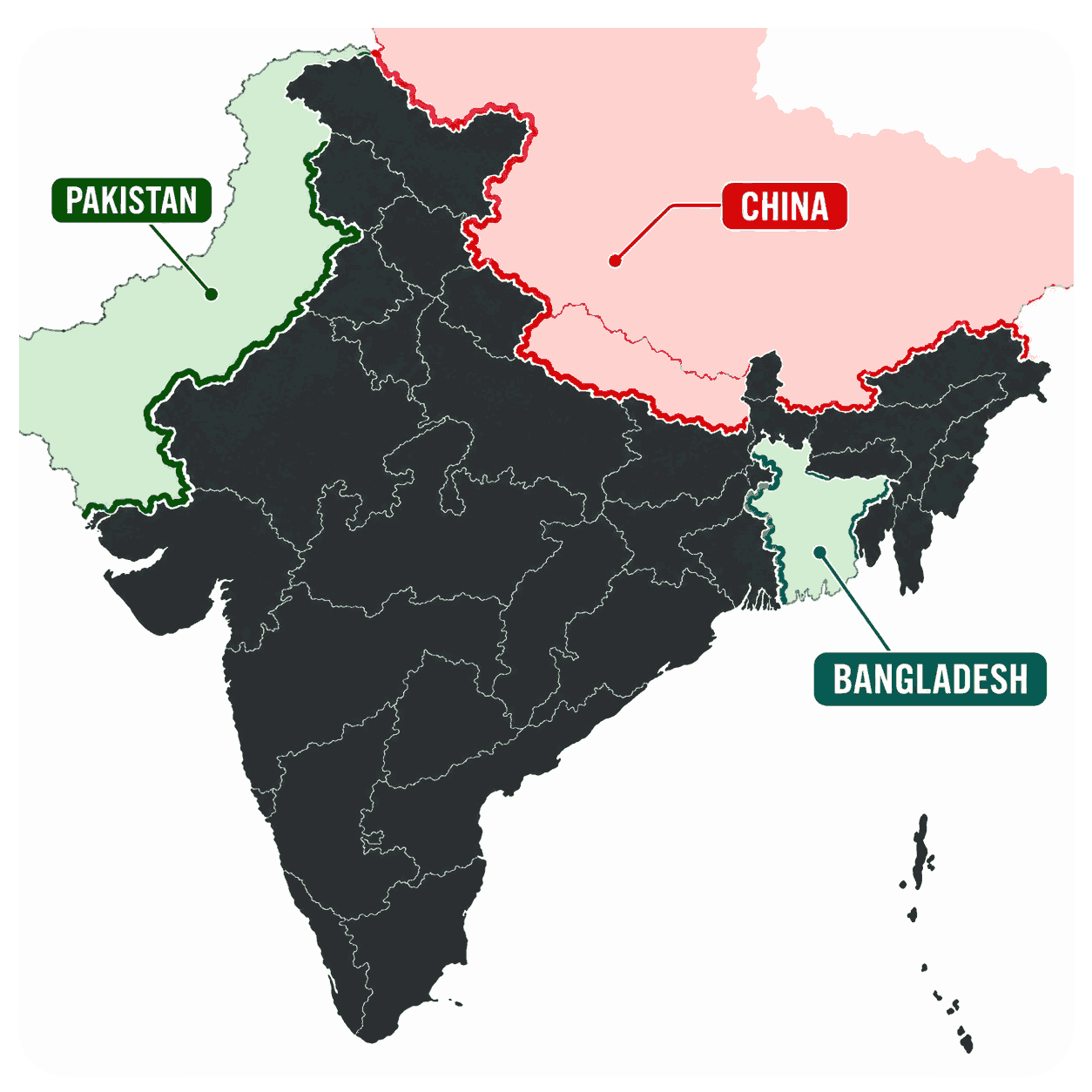

Land-Bordering Countries
Under the current guidelines, prior government approval is required to make investments where the investor or ultimate beneficial owner is based in a country sharing a land border with India, unless specifically exempted by policy.

New Definition of Beneficial Ownership
Now, the definition is aligned with the Prevention of Money Laundering Rules, 2005. This new update by the government has removed the statement regarding minor indirect exposures for foreign funds.

60-Day Timeline for Approvals
The government of India has indicated an aim to process proposals within defined timelines in order to minimize administrative delays and support local manufacturing. However, the actual processing time may vary depending on the sector and complexity of the proposal.
Automatic vs Government Route
FDI Routes: Automatic Route vs Government Route
The Foreign Direct Investment (FDI) in India generally flows through two routes, including the Automatic Route and the Government Route. In the Automatic Route, the foreign investors don't require taking the RBI or government approval for foreign direct investment (FDI). But, in the Government Route, they generally need to follow strict formal regulatory compliance. The FDI approval process can be understood as follows:
Automatic Route
For international investors, the Automatic Route tends to be faster and simpler , like almost straightforward. On this route, you do not need prior approval from the RBI (Reserve Bank of India) or from the Government of India either . As a foreign investor you just notify the relevant regional office of the RBI within 30 days after inward remittances are received , thats it. In addition, a number of segments across areas like manufacturing, IT, renewable energy, biotechnology, and some pharma as well as telecom activities allow as much as 100% FDI through the Automatic Route , provided there are sector wise limits and conditions , as per the most recent FDI policy.
Government Route
Government approval is required for investments in restricted or strategic sectors, including where the ultimate beneficial owner is from a country sharing a land border with India, as per the current FDI policy. If any international investor applies through the FDI Government Route, they must submit an online application on the Foreign Investment Facilitation Portal (FIFP). Once application is submitted, it will be verified by the relevant governing authority. Various major sectors require FDI government approval, and these sectors are defence manufacturing, print media, broadcasting, satellites, retail trading, and certain banking services.
Documents Required
Required Documents for FDI in India
For Foreign Direct Investment (FDI) in India, international individuals or businesses are required to provide documents related to the corporate entity, proof of funds, and regulatory compliance. Furthermore, the document requirement depends on FDI routes, whether applying via the Automatic Route or the government approval route. Look at the document requirements at a glance:
📌 Corporate & Investor Documents
- Certificate of Incorporation, MOA, and AOA of the foreign investing entity
- Recent audited tax return and annual financial statement.
- Board resolution and Power of Attorney (POA)
- Directors' and shareholders' address proof and passport copies
📌 Banking & Transaction Documents
- A debt certificate or FIRC obtained from an authorized dealer bank is required.
- Valuation certificate from a SEBI-registered merchant banker or CA
📌 Government Approval Route (If Applicable)
In case any international entity or individual applies for FDI under the government approval route, the major documents required are:
- A complete summary of FDI ApprovalSecurity clearance form (mandatory if your country shares a land border with India)
- Foreign promoters' & collaborators' identification proof
- A sector-specific certificate (e.g., a non-compete clause for the pharmaceutical sector)
_1783942339.gif)
Process
Complete Foreign Direct Investment (FDI) Process
Automatic Route
Under the Automatic Route, foreign investors don't require any approval from the Government of India. The process is as follows:
Step 1: Verify Eligibility & Limits
Before FDI in India, international investors must check the business sector to ensure whether it is eligible or not. Further verify the permissible sector cap; for example, it is 100% in manufacturing.
Step 2: Transfer the Funds
The investment amount must be transferred in foreign currency through a designated authorized bank into the Indian company's bank account
Step 3: Assign Shares
Once the investment amount is transferred, the designated Indian company's Board of Directors needs to allot the shares. It is mandatory to allot shares within 60 days of receiving the funds.
Step 4: File Form FC-GPR
Form FC-GPR is an RBI reporting form that is filed by the Indian company when it issues shares or other capital instruments to foreign investors, and it must be filed within 30 days of the allotment. On the portal, the Indian company also needs to attach the supported KYC documents and the Foreign Inward Remittance Certificate (FIRC).
Government Route
The FDI Government Route is mandatory for sensitive sectors and has specific caps or involves restricted ownership. The process is as follows:
Step 1: Navigate the FIFP Portal
Before accepting funds, filing the application online on the Foreign Investment Facilitation Portal (FIFP) is mandatory. You are required to file an online application via FIFP, including submitting a detailed project report and security clearance information.
Step 2: Examination by DPIIT
Once the application is verified by the Department for Promotion of Industry and Internal Trade (DPIIT), it will assign the proposal to the respective administrative industry or department.
Step 3: Inter-Ministerial Review
The respective administrative department further circulates the proposal to other relevant departments for verification. The Ministry of Home Affairs carries out security checks, whereas the RBI examines compliance with financial regulations. This review process typically takes around 8–12 weeks, depending on the proposal.
Step 4: Approval Letter
The government allots the official approval letter once it is cleared, including details about any specific conditions.
Step 5: Fund Inflow & Reporting
Once the approval letter is issued, the foreign investors can remit the funds, and the Indian company is required to allot the shares. The company is responsible for reporting the transactions within 30 days on the FIRMS portal as outlined in the Automatic Route.
Ongoing FDI Compliance
What Is Ongoing FDI Compliance in India?
To stay active with the ongoing compliance for the FDI in India, it is crucial to follow up on the transactional, event-based, and annual reporting activities. The core FDI compliance is
 (1)_1783945943.webp)

Form FC-GPR
Filing this form is mandatory after sharing the allotment through the FIRMS portal. It must be filed within 30 days of the share allotment when an Indian company receives foreign capital and issues equity instruments.

Form FC-TRS
Required when the capital instrument is transferred between a non-resident party and a resident party via sale or gift. File within 60 days of the capital instrument or fund transfer.

Annual FLA Return
The foreign liabilities and assets return must be filed and submitted directly to the RBI (Reserve Bank of India). The deadline for the annual FLA return is July 15 every year.
Why Choose JustStart?
Why Choose JustStart for an FDI Consultant in India?
JustStart offers a complete legal consultancy service, with a focus on getting the best legal advice accurately. Our dedicated and experienced team members ensure accurate speed of processing and full FEMA compliance. Consider these core reasons to choose us for your FDI consultation:

Fast-Track Registration:
Our dedicated team of professionals, like chartered accountants and company secretaries, is active in multiple sectors for company registration and compliance filings. They handle the end-to-end incorporation process, including DSC (Digital Signature Certificate), DIN (Director Identification Number), and MCA approvals.
Helps to Choose the Right Route
We assist you in determining whether the Automatic Route or the FDI Government Route is ideal for you, as it directly helps to avoid delays and rejection.
FC-GPR & FLA Filing Accuracy
Complete post-investment support as our experts manage mandatory reporting to the RBI, such as the advance reporting form and Form FC-GPR when issuing shares to foreign investors.
Ongoing FEMA Compliance Monitoring
We ensure that you are active with the NDI rules and regulations, including the pricing policy and the reporting period post-investment.
Resident Director Service
Here, you will get a complete solution for the resident director requirements. Furthermore, JustStart's core executive team members ensure local compliance with Indian legal formalities where foreign nationals serve as board members.
Locations
Foreign Direct Investment in States & Cities
FAQs
LET'S CLEAR ALL THE DOUBTS!
The Foreign Direct Investment (FDI) is a long-term investment method where foreign investors gain a lasting interest and a controlling stake. The foreign investor from one country establishes a lasting interest in another country's business.
In both FDI (Foreign Direct Investment) and FPI (Foreign Portfolio Investment), foreign capital enters a country. However, they significantly differ in intent and control. In FDI, the foreign investor gets a long-term stake in a physical operation, whereas in FPI, it involves passive, short-term investments in financial assets like bonds and stocks.
FDI and ODI (Overseas Direct Investment) are two different methods of cross-border business investment. FDI follows the inbound direction in which the capital comes into your country from abroad, while ODI follows the outbound direction in which capital flows out of your home country into foreign markets.
Under Automatic Route, foreign entities or individuals don't require prior government approval for specific sectors. Meanwhile, the major sectors that follow this route are telecommunications, manufacturing, IT & BPM, renewable energy, biotechnology, pharmaceuticals (Greenfield), infrastructure, and airports. The other sectors include hospitality, healthcare, food processing, textiles, gems & jewelry, asset reconstruction companies, and e-commerce activities.
The Government Route is a way for Foreign Direct Investment (FDI) in India. Under this approval route, the foreign investors are required to get written permission from the government before making any investment. Prior government approval for FDI is required for investors or ultimate beneficial owners from countries sharing land borders with India, unless specifically exempted by policy.
Form FC-GPR stands for Foreign Currency-Gross Provisional Return. It is a compulsory transaction-based reporting form that is used by Indian companies. Through this form, the Indian entities inform about the issuance of capital instruments to overseas investors.
Form FC-TRS is a compulsory regulatory filing that must be submitted on the RBI FIRMS portal to report the transfer of capital instruments between Indian residents and foreign non-residents.
No, there is no legal baseline for the minimum investment amount. However, the foreign investors are generally required to align with strict guidelines (fair market value).
The timeline depends on the sector-specific and security clearance; however, the general period is around 8-12 weeks. This is an indicative timeline and may vary based on the proposal complexity.
Foreign Direct Investment (FDI) can be made into an LLP (Limited Liability Partnership). Meanwhile, for this investment, the foreign investors are required to meet the specific guidelines.