
Copyright Registration Online in India
Copyright registration in India protects your creative works such as literary, musical, dramatic, artistic, cinematographic, and sound recordings. Get exclusive copyright rights for your original and creative work, as JustStart helps with handling documentation, application drafting, and follow-ups with the Copyright Office.
- Certificate Issuance: 3-6 Months
- Lifetime +60 Years Validity
- Copyright Office e-Filing Portal
- 30-day objection window
- Add Ownership in Court
Everything included in your Copyright Registration package
- File Application Form XIV
- Prepare & Review All Documents
- Objection/Discrepancy Notice Handling
- 100% Online Filing- No Physical Visit
- Personalized Copyright Consultation
- Copyright Symbol (©) Usage
Request a Callback

4.9 star all time rating

4.8 star all time rating
Overview
What is Copyright Registration in India?
Copyright registration involves a lengthy legal process to provide exclusive rights for an original work of creation. Copyright in India is administered under the Copyright Act of 1957 and the Copyright Rules of 2013. Through registration, individuals get the rights over how their original work is used, copied, or broadcast.
However, the individual gets automatic copyright protection when a work is created. But registration provides legal rights and access to various benefits. In court, during an objection, a registered copyright serves as "prima facie evidence". The purpose of copyright is to safeguard the original expressions, not the ideas of any work. Further, copyright protects the original work from theft by others without permission. The owners also get the right to take legal action against third parties who break the rules and profit from the damages.
Categories
What Can Be Copyrighted?
For copyright protection, there are only six categories listed under Section 13 of the Copyright Act, 1957. These are the six major categories that qualify for copyright registration in India:
✅ Literary Works: Books, articles, poems, blogs, source code/software, databases, lyrics
✅ Dramatic Works: Scripts, screenplays, choreography, stage directions
✅ Musical Works: Musical notations, compositions (the music itself, separate from lyrics or recording)
✅ Artistic Works: Paintings, drawings, logos, sculptures, photographs, maps, architectural designs
✅ Cinematograph Films: Movies, web series, ads, documentaries, video content
✅ Sound Recordings: Podcasts, music albums, audiobooks, voiceovers
What Cannot Be Copyrighted?
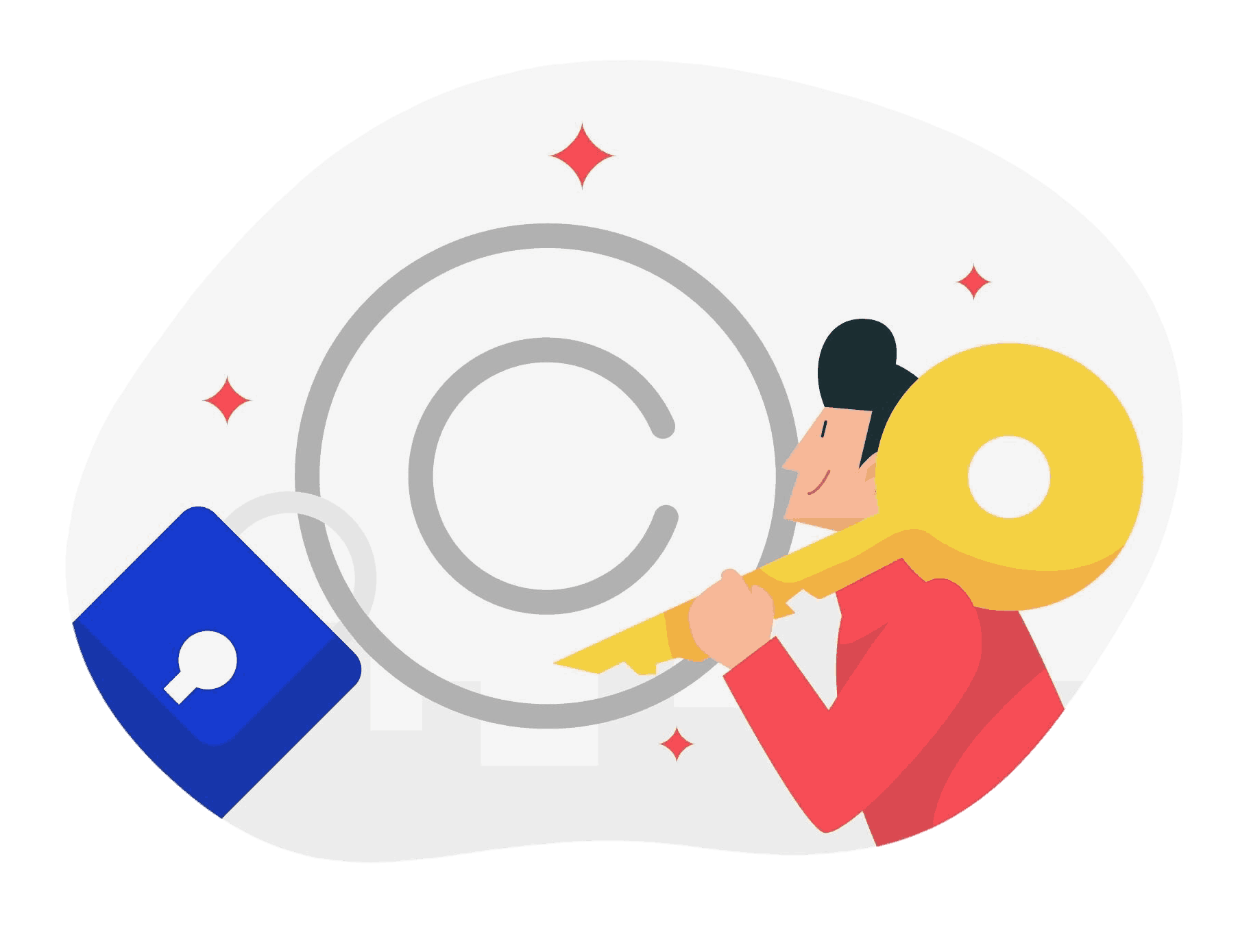
Individuals can only copyright the impressions, not the ideas. There are also a few categories that fall under trademark registration or patent, not copyright. You cannot copyright the ideas and concepts. The title, names of any brand, logo, or phrase, come under trademark, not copyright. Works that are also in the public domain are restricted from copyright protection.
Benefits
What Are the Benefits of Copyright Registration?
The copyright registration in India creates an official legal public record of authorship and ownership. But the major purpose of copyright registration is to provide legal proof and validity to use the original work without other involvement, preventing unauthorised access to benefits in court. These are the major features determines why copyright registration is crucial:

Public Records of Ownership
The registration creates a public searchable database on the internet through which the general public can identify the owner of the original work, the author's name, and the creation date. The searchable public records help to contact the copyright holder.
Legal Ownership for Evidence
Having valid copyright ownership provides the authority to take action against third parties who are illegally using your original mark without permission. The copyright certificate serves as legal evidence in court and verifies that you are the original owner.
Full Access to Earn Profit
The owner of the original work holds complete control over their creations; therefore, they can sell or use them to earn money. It not only makes you liable to secure your creativity from third-party use but also provides access to use it for profit (earn money).
Eligible for Statutory Damages & Attorney’s Fees
Often, the owner of the work does not need to prove the financial loss due to copyright use; instead, the court awards a fixed monetary amount set by law. Further, the petitioner can recover the legal and court costs from the infringer, making legal representation far better.
Difference
Copyright vs Trademark vs Patent: Core Difference
All copyright, trademark, and patent registration are designed mechanisms to safeguard different kinds of Intellectual Property (IP) in India. Understanding these three mechanisms is crucial to verify which you should apply to your creation:
|
|
|
|
|
|
|
|
|
|
|
|
|
|
|
|
|
|
|
|
|
|
|
|
|
|
|
|
|
|
|
|
|
|
|
|
|
|
|
|
|
|
|
|
|
|
|
|
|
|
|
|
|
|
|
|
|
|
|
|
Copyright Rights
Rights You Get as a Copyright Owner
After securing exclusive rights after online copyright registration in India, the owner gets sole access to use their original creativity in any format. However, if any third party uses your original work even after securing exclusive rights, it triggers copyright infringement. These are the major rights you get as a copyright owner:
✔️ Right to Make Copies:
The copyright owner holds complete ownership of the right to make copies of your original work. For example, a book can be copied onto a CD, DVD, video, or audio format.
✔️ Right to Re-Create the Work:
The owner has the right to change, modify, or create a new version of the work he or she owns.
✔️ Right to Distribute Your Work:
After completing the copyright process, the owner of the work is entitled to control how the product gets sold, rented, or otherwise distributed.
✔️ Right to Publicly Perform:
The copyright owner holds the right to handle public performance activities. For example, can set the schedule for the concert or live performance, first film launch, or song, etc.

Documents Required
Documents Required for Copyright Registration
The application, along with the documents, is submitted on the Copyright Office e-filing portal. Various core documents required for copyright registration in India, along with additional details, depend on the nature of the work. Here is the complete checklist of documents for online Indian copyright registration:
- Application Form (Form XIV): The primary statutory legal application form covering Statement of Particulars (SOP) & Statement of Further Particulars (SOFP).
- Identity & Address Proof of Applicant: PAN card, Aadhaar card, passport, or voter ID (any one of the documents).
- Copies of Work (two copies): If sending copies of work online, upload in digital format such as PDF, JPEG, or MP3. If applying offline, provide the physical work copies.
- Power of Attorney (if Applicable): Hire any agent/attorney to file the copyright application on your behalf.
- NOC from Author: A No Objection Certificate (NOC) from the original author must be signed if the application is filed by another person.
- Copyright Assignment Deed/Agreement: Required if the original work is transferred or purchased from the original author to the applicant.
- NOC from Publisher: Required only if the work is already published by a third-party publisher.
- Certificate of Incorporation/ Board of Resolution: Required if the applicant is a company, trust, LLP, firm, etc.
Category-Specific Documents
- Literary Work & Software: Two hard copies of the books, articles, or poems in PDF format. The unedited source code and object code are printed or saved digitally for computer software.
- Musical Work: Graphical score or music sheet showing melody and harmony. If you want independent protection for your written text, provide a separate document or audio sample if the composition has been performed/recorded.
- Artistic Work: Two visual copies of your painting, drawings, or sculptures, including design descriptions for works of artistic craftsmanship.
Process
How to Apply Online for Copyright Registration?
Content can be registered for copyright online in India by logging on to the Copyright Office’s official website (copyright.gov.in) under the purview of the Ministry of Commerce and Industry. The following outlines the process for online registration of copyright:
Visit the Official Copyright Office Website
Visit the copyright.gov.in portal and click on the option “New User Registration”. Enter your details to create a new user account. Once the account is created on the portal, log in by entering your username and password.
Fill Out Form XIV
Navigate the dashboard and proceed to “Click for Copyright Registration”. Select the appropriate category among the six work sections, including Literary, Artistic, Musical, Sound Recording, Software, and Cinematograph Film. In the application, further mention the work title, date/country of publication, and the details of the applicant (individual or organization).
Attach the Documents & Statement of Further Particulars
Attach all relevant supporting documents along with identity and address proof, including copies of the author’s original work. Beyond this crucial document, you are also required to attach the additional original work-related documents and the Power of Attorney, NOC from the owner, or assignment deed
Pay the Registration Fees
Pay the registration fees via any prescribed gateway. The cost of registration generally depends on the original work. The registration cost ranges from ₹500 to ₹5,000 per work.
Submission & Diary Number Generation
Once the payment is done, submit the form. The portal generates a diary number, which you use for application tracking. Note down your acknowledgement number and print it out.
30-Day Waiting Window & Certificate Issuance
After the diary number generation, the 30-day waiting window starts when the application details are published to the general public records. After completing the 30-day waiting period, the application enters verification by the examiner. You will receive the notice at the registered email address if an objection is raised and are required to submit a reply within 30 days. Upon successful application approval, a digital copyright registration certificate is issued.
Status
Process to Check Copyright Application Status
The applicants can check the status of the copyright by using the Diary Number generated during the registration process. Here is a step-by-step guide to check the copyright application status:


Step 1: Visit the Official Portal
Visit the official copyright office portal “copyright.gov.in”.
Step 2: Navigate to the Application Status
On the home page of the portal, click on the option “Status of Application” or “Diary Status”.
Step 3: Enter Your Diary Number
In the search box, enter your Diary number, which you received during the payment procedure. The diary number is printed on your payment acknowledgement.

Step 4: Submit & View Details
Click on the option “Status View” or “Search”. The portal will display the status of the copyright application. You can further view the historical updates on the portal.
Fees & Timeline
Copyright Registration Fees and Timeline
The copyright registration cost in India is entirly depends on the work category. The cost for the copyright is categorised as:
|
|
|
|
|
|
|
|
|
|
|
|
Timeline for Copyright Online Registration
It generally takes 6-8 months to complete the copyright registration process from starting the filing to approval. The 30-day waiting period is mandatory, during which the application records are live in public records. In case an objection is raised, that may delay the hearing of the issue by as much as six months. Before filing the final application, it is important to make sure that all forms and documents are perfect, in order to prevent the issue from becoming stale.
Validity
Validity of Copyright Protection
A person gets copyright protection at the moment when the work is created. However, registration provides legal ownership to the original creator. Further, the validity of copyright generally depends on the work category.
Validity for Literary/Musical/Dramatic/Artistic Works
Under this category, the work is generally valid for the lifetime of the author and even after their demise. It means the owner gets the original work category ownership till its demise. If the author dies, the copyright ownership continues for a further 60 years. During this duration, no one can make a copy and steal it to convert it into another format.
Validity for Sound Recordings, Films, Photographs, Government Works, etc
For these categories, the copyright validity is 60 years from the year of publication. It means that the day the copyright is registered for this category, the copyright ownership continues for 60 years. Once the 60-year countdown ends, the work category enters the public domain.
Why Choose JustStart?
Why Prefer JustStart for Copyright Registration?
Right guidance and support help to simplify the statutory and compliance formalities. That’s where JustStart meets all the required formalities to ensure a smooth and fast registration for copyright in India.
Professional Assistance on Work Classification
It is crucial to file for the right work classification for a specific category under the Copyright Act, 1945. Our professional experts ensure and provide assistance in filing under the right work classification so that no issues arise during the verification phase.
Manage the Copyright Documents
The biggest challenge is to prepare and verify the correctness of copyright documents. But these hurdles are all simplified by our experts manages document drafting, formatting, and verification to eliminate missing-document flags.
Prevent Discrepancies by Removing Errors
A minor error related to the author's name, publication date, and other details triggers a notice of “Formality Check Fail” or “Discrepancy”. The dedicated experts of JustStart verify all details' correctness to avoid such errors.
Track Application on Portal
You are not alone. You get support if any query is raised by the third party. Our experienced team tracks the status of your application and further drafts the response within the prescribed timeline.
100% Online Process & Transparent Pricing
The copyright registration process is completely online. It helps you to ensure each step’s correctness and verify if any issue is created. Further, our transparent pricing and service quality will please you, helping to make the registration process faster and error-free.
Locations
Copyright Registration in Other States and Cities
FAQs
LET'S CLEAR ALL THE DOUBTS!
No, copyright registration is not mandatory in India. Copyright protection is automatic the moment the original work is created.
The copyright registration process in India generally takes 6-8 months if there is no objection raised by a third party. However, if an objection is raised, the process can extend to 8-12 months.
The official government cost for copyright registration in India generally ranges from ₹500 to ₹5,000 per work. The exact cost depends on the original work category.
Copyright works as a protection shield for artistic and literary works. Copyright protects original work the moment it is created. Meanwhile, a trademark protects a brand’s real identity, such as a name, logo, slogan, or any specific mark that represents that brand identity.
The copyright protection of Literary/Musical/Dramatic/Artistic Works is generally valid for the lifetime of the author plus 60 years. But for sound recordings, films, photographs, government works, etc, copyright status is valid for 60 years from the day published. The moment the validity ends, the original work enters the public domain.
Yes, you can definitely apply for copyright registration for an unpublished work. Under the Indian Copyright Act, 1957, anyone can register a copyright for an unpublished or published work.
An individual cannot apply for copyright for a complete AI-generated work without human effort and invention. An author is restricted from getting the status of copyright protection if it does not pay for its own efforts, skills, original expression, and judgement. However, the same author can apply for copyright if they only use the AI as a tool for ideas, control, and modification.
Under Section 13 of the Copyright Act, 1957, the author/artist can apply for copyright registration under the six major categories, which include “Literary Works, Dramatic Works, Musical Works, Artistic Works, Cinematograph Films, and Sound Recordings”.
If you receive the copyright notice during the registration process, submitting the formal written letter to the Registrar within 30 days is compulsory. To reply to the notice, first read the reason for the objection and then gather the documents to verify your work's originality.
The copyright registration certificate is a legal government document that is issued by the Copyright Office in India. The certificate serves as the legal proof of ownership and public record for the creator.