

Shop and Establishment Registration Online in India (Shop Act License)
Register for a Shop Act license to legally operate your commercial establishment in India. Failure to apply for the Shop and Establishment Registration (Also Known as Gumasta or Trade License) within 30 days of commercial establishment triggers possible business closure and legal penalties. Align your business operations with the laws governing the labour industry. JustStart is your legal advisor, assisting with initial documentation for the approval of the shop and establishment license.
- 1-7 Days Online Filing
- 15-30 Days Offline Filing
- State-Level Law
- Labour Regulation
- State-Specific Validity
Everything Included in Your Shop and Establishment Registration Package
- State-Specific Regulation Guidance
- Complete Document Preparation
- End-to-End Compliance Handling
- Technical Support for DSC
- Employee Record Setup
- Application Filing Support (Online/Offline)
Request a Callback

4.9 star all time rating

4.8 star all time rating
Overview
What is a Shop and Establishment Registration in India?
Shop and Establishment registration is a comprehensive procedure to register with the state labour department for the “Shop Act license”. The “Shop and Establishment Act 1954” is state-specific, governed by the labour department (and the local municipal corporation in Maharashtra). Registration is commonly known as a shop and establishment in various states, but in Maharashtra it is called a “Gumasta License”.
Under the Shop and Establishment Act 1945, registration is mandatory for anyone who wishes to establish a private commercial business in a specific state and hires staff, but commercial factories are exempted as they are governed under the Factories Act. The Act provides the legal framework to regulate working conditions in commercial establishments, including protecting the rights of employees, and significantly focuses on the labour sector.

Employer Rules
Key Employer Rules Under the Shop Act
A shop license requires commercial businesses to adhere to the state labour norms. The core labour standards are:


Working Hours
The Shop and Establishment Act, 1954, ensures that working hours of commercial businesses adhere to labour standards such as weekly and daily working hours, rest intervals, and closing/opening times.

Leave and Wages
It covers the mandatory weekly off-days, policies for casual/sick/earned leave, and overtime settlement rules.

Employment Protection
The Act prohibits child labour, including a focus on health/safety compliance for women working night shifts.

Workplace Health & Safety
Ensures that commercial establishments must focus on basic hygiene, ventilation, lighting, and fire safety precautions.
Who Needs?
Who Needs to Register for a Shop License?
The shop and Establishment registration is legally compulsory for every business that operates commercial activities (factories are exempted as they operate under the Factory Act). This license is not based on business type, but it is required whenever a business operates commercial activity with a physical office registered in a specific state's jurisdiction. The common players that must obtain a "Labour License" are given below-
Retail and Wholesale Outlets
Grocery shops, fashion retail shops, electronics shops, supermarkets.
Commercial Offices
Software/IT companies, startups, financial firms, consulting offices, logistics hubs, and marketing agencies.
Service Providers & Entertainment Establishments
Salons, spas, gyms, dry cleaners, tailoring shops, and diagnostic centers; movie theatres, amusement parks, bowling alleys, and gaming arcades.
Hospitality & Food Businesses
Restaurants, cafes, food trucks, hotels, bars, and catering businesses.
Warehouses & Godowns
Any storage space or distribution center used for commercial trade.
E-commerce Business
Mandatory if sale online but have a physical office, warehouse, or fulfillment center to handle the inventory.
Not Eligbile
Who Are Not Eligible for a Shop License?
If you fall under these categories, then you are not required to apply for the shop and establishment registration:
❌ Manufacturers & Factories
The large manufacturing units and factories are governed by the strict Factory Act, 1948.
❌ Government Departments (Specific Private Bodies)
The central, state, or local government bodies, including private bodies under government undertaking, are exempted.
❌ Individuals with Legal History
Minors and individuals with a criminal history are also not eligible.
❌ Agriculture Departments
Farming, harvesting, and cultivation are not considered commercial activity.
❌ Exemption in Maharashtra (Employee-based Rule)
If any startup in Maharashtra has zero or fewer than 10 employees, including operating any home-based business, online freelancing, or micro-retailer, it is not required to obtain the license.
❌ Exemption in Karnataka
Small commercial offices or retail outlets in Karnataka are not required to obtain a license unless they have 10 or more employees.
❌ Non-profit Educational Institutions
The non-profit educational institutions (affiliated with boards like CBSE, ICSE, or State Boards) are exempt from the Shop Act license registration.
❌ Karnataka vs Maharashtra (license formality)
In most states (like Karnataka), hospitals and clinics are exempt from the shop license, but in Maharashtra, hospitals and clinics are covered under the Shop Act and enjoy vast exemptions.
❌ Private Banks
Several private banks like HDFC, ICICI Bank, Kotak Mahindra, Axis Bank, etc are exempted from a shop and establishment license.
Benefits
Benefits of Shop and Establishment Registration
The holders of a shop act license enjoy various benefits, and it is helpful during the opening of a current business bank account. The core benefits associated with a shop license are:


Used to Open a Business Bank Account
The shop and establishment certificate is the primary document to open a current business bank account. Under the strict Know Your Customer (KYC) guidelines, commercial establishments are required to submit a copy of the shop license, as it works as proof of the physical business location.
Boost Business Authority & Credibility
Having a valid shop and establishment license demonstrates that the business is compliant and adheres to the governing authority’s strict laws. It provides the legal rights to operate lawfully without any extra disturbance. It further boosts the credibility of the business in competitive markets and looks more trustworthy in front of the customers.
Helps to Claim MSME & Government Incentives
To grow micro and small businesses, the Indian government is helping via beneficial incentives and tax perks. With a valid shop license, businesses can register for the Udyam MSME registration. Once you get the MSME status, you can claim subsidies, access to collateral-free bank loans, and Protection against delayed payments from buyers.
Base Document for Other Registrations
FSSAI license is the primary document to start a food business in India. Here, the shop act license works as the primary document required during FSSAI documentation. It works as physical business proof. Overall, the shop and establishment license works as the base document for registration, like GST registration, FSSAI registration, MSME Udyam registration, etc.
Legal Structure for Employee Protection
The Shop and Establishment Act, 1954, is heavily compliant with labour laws, which are strictly designed for the employees. It safeguards the employee’s rights and ensures they receive maximum wages and double salary for overtime. It overall covers the working framework for the employees and protects the employer from workplace disputes.
Documents Required
Documents Are Required for a Shop License in India
The exact documentation for Shop Act Registration depends on the state’s specific jurisdiction. However, the following is the list of documents required in each state during shop and establishment registration:
Document for All Businesses
- Proprietor/authorized signatory’s passport-size photograph
- PAN card for identity proof (of the owner or entity itself as applicable)
- Aadhaar card of the applicant
- Proof of the address of the commercial location (for example, a utility bill, water bill, or property tax bill not older than two months)
- The title deed/sale deed (if the property is owned) or rent agreement (if the property is rented)
- An NOC from the landlord (if the property is rented)
- The photo of the shop/company that shows the name board
- The complete explanation of the type of business or trade
- The total number of employees (by gender distinction if needed by law)
Documents for Sole Proprietorship
- Aadhaar and PAN of the sole proprietor
- Bank account information/cancelled cheque (in the name of proprietor or company)
- GST certificate (optional but better to have one)
- Udyam/MSME registration certificate (if available)
Documents for Pvt Ltd/LLP
- Certificate of incorporation (RoC)
- MOA and AOA (in case of private limited companies)
- LLP agreement (in case of LLP)
- PAN card of the company/LLP
- ID and address proof of all designated partners/directors
- Board resolution or authorization letter (if required)
- Digital Signature Certificate (DSC) for digital application submission and signing
- CIN (Corporate Identification Number) or LLPIN, as applicable
Documents for Partnership Firm
- Partnership deed (document mentioning partner’s names, signatures, and profit-sharing ratio)
- Partnership firm PAN card
- Aadhaar and PAN of all partners
- Board resolution/authorization letter (if necessary)
- Registration certificate from the Registrar of Firms (if necessary)
Employee Threshold
Employee Threshold by State
The Shop Act law is state-wise. The employee threshold is vary state or state and determines when registration is required. In some states, registration is mandatory even if they have only one or zero employees. Here is the complete checklist for employee threshold by state:
|
|
|
|
|
|
|
|
|
|
|
|
|
|
|
|
|
|
|
|
|
|
|
|
|
|
|
|
|
|
|
|
|
|
|
|
|
|
|
|
|
|
|
|
|
|
|
|
|
|
|
|
|
|
|
|
|
|
|
|
|
|
|
|
Note: To check the exact employee threshold limit, you must visit your state’s labour department portal. For example, to check the limit for Punjab, visit the Punjab Labour Department's e-Labour portal “pblabour.gov.in”.
Shop Act, Gumasta & Trade License
States and Common Name of Shop Establishment License
As the rules for the Shop Act license vary from state to state, it is also known by different names in different states. In a few states like Delhi, UP, and Haryana, it is known by its original name. It can be understood as:
✅ Maharashtra: Gumasta License / Gumasta Certificate
✅ Gujarat: Gumasta License / Gumastadhara / Trade License
✅ Bihar: Trade License
✅ Delhi, UP, Haryana: Shop and Establishment License (known by its legal name).
✅ Karnataka: Shop Act/Labour License (distinguishable from the respective municipal Trade License)
✅ Many Other States Generally: "Trade License" is a widely utilised informal umbrella term, though technically the Trade License and Shop Act License are separate registrations in most states.
Procedure
Step-by-Step Guide: Shop Act License Registration Process
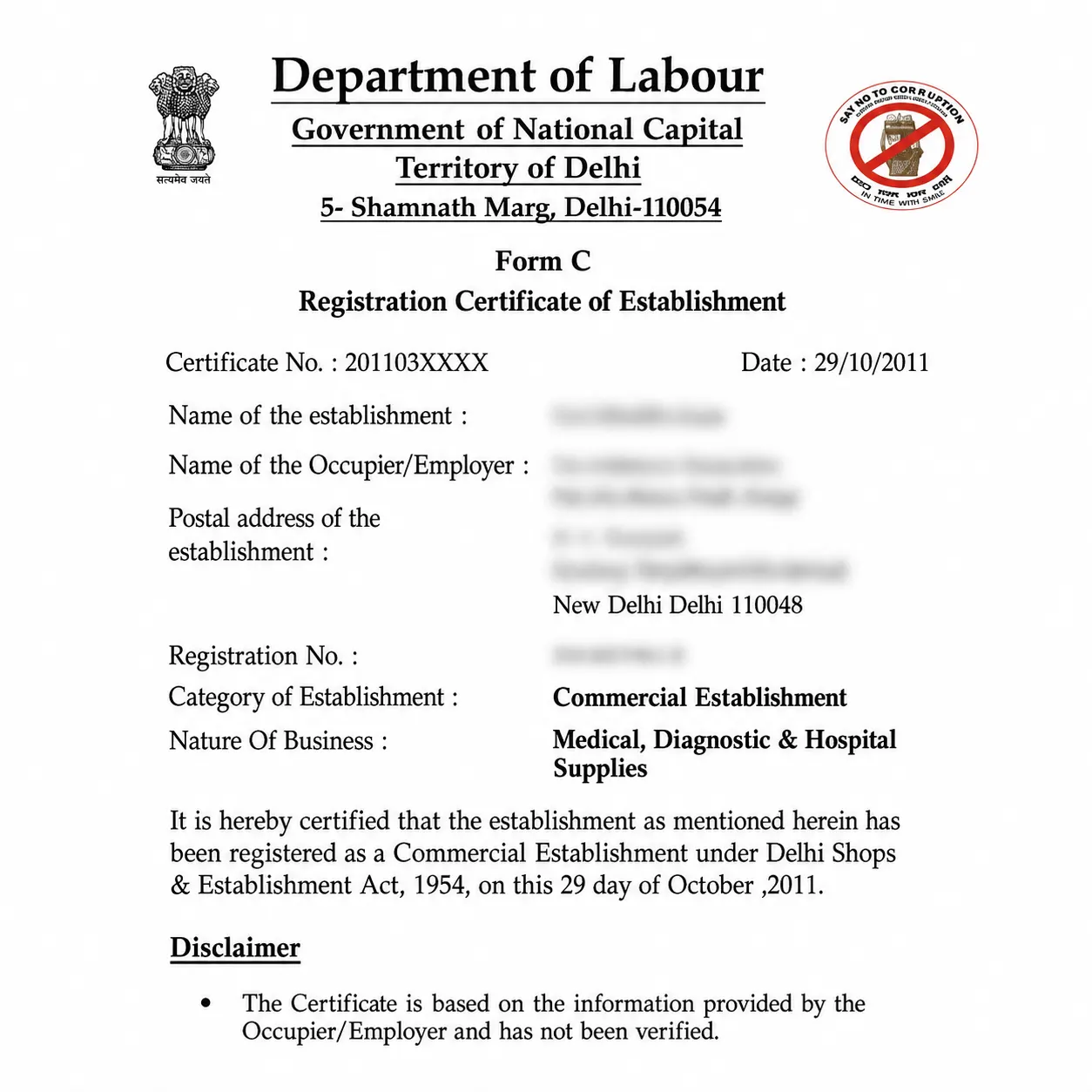
In most states, the shop and establishment registration process is completely online. The complete digitalization made the process faster and more transparent. Here is how you must apply for the registration certificate:
_1786011473.png)

Step 1: Determine the Registration Requirement
Before starting the registration, you must verify whether you require the certificate or not. If you are operating any commercial establishment in Delhi and employ 20 or more workers, then registration is mandatory for you. To know the threshold limit, visit your state’s Labour Department portal.

Step 2: Verify Your State’s Portal
Each state has its own portal for filing, it is crucial to verify your state’s labour department portal. For example, if you are applying in Mumbai, Maharashtra, for the “Gumasta license,” visit aaplesarkar.mahaonline.gov.in. For Delhi, the portal is labourcis.nic.in or the Delhi e-District portal. Some states allow registration via the National Single Window System (nsws.gov.in).

Step 3: Prepare the Required Documents
Gather the major documents like ID proof, PAN, Aadhaar, premises proof, business structure documents, employee details, and a shop nameboard photo. The additional documents required based on your business structure (sole proprietor, partnership, or company/LLP).

Step 4: File Application On Portal
Register on your state’s labour department portal by using your email address/contact number. Complete the application form by mentioning your business details like name, address, and nature of trade, including also the date of commencement, employee count, and their information, and owner/partner/director information.

Step 5: Pay Fees and Track Application
Pay the government processing fees, which range from ₹500 to ₹500, depending on employee count and specific state. Once a payment is made, save the challan, as the reference number helps to track the application.

Step 6: Premise Verification (If Applicable)
Before the final approval, the labour inspector may verify the premises and documents. The inspection is usually conducted for the larger establishments who crosses the threshold limit. However, the micro and small establishments usually skip this step.

Step 7: Download Certificate and Display
Upon final approval, you must download the certificate as it is available digitally. It is legally mandatory to display the certificate at your business location.
Cost & Timeline
Cost and Timeline of Shop & Establishment Registration
The cost for a shop and establishment depends on the specific state and the employee count. The processing timeline further varies from state to state; some states complete in 3-7 working days, or in some states, the process is instant online. The cost for a shop act license ranges as follows:
✔️ 0 Employees: If the establishment is operated by solo owners (with no employees), the cost for the shop license is zero or optional. But some states charge even if there are no employees in an establishment. The establishment registration is compulsory in Karnataka and costs ₹250 for sole proprietorship. In Gujarat, the cost is ₹100, and in West Bengal, it is ₹250. In Gujarat, the cost is ₹100, and in West Bengal, it is ₹250. Whereas the Karnataka labour department does not charge, establishments in this state are only required to inform the labour inspector.
✔️ Below 10 Employees: Most states charge no fees for registration. However, Punjab is exempt from registration if it has fewer than nine employees. Karnataka has registration fees between ₹250 and ₹1,500. Gujarat has registration fees between ₹100 and ₹800, while West Bengal charges between ₹250 and ₹1,500.
✔️ 10-19 Employees: Establishment registration in Delhi, Haryana, Maharashtra, and Uttar Pradesh is free as long as any establishment has fewer than 20 employees. Punjab remains completely exempt from any registration. However, in Karnataka, registration fees vary from ₹1,500 to ₹3,000. Tamil Nadu charges fees of ₹150 to ₹3,000 if any commercial establishment employs 10 or more workers. Gujarat and West Bengal also require payment, as prescribed by the labour department.
✔️ Above 20 Employees: if any commercial establishment employs above 20 employees, it has to pay registration fees of ₹500 to ₹5,000. Registration fees of some states such as Haryana, Uttar Pradesh, and Punjab are not available in public records. However, some sources mentioned that the shop and establishment registration process is free of cost in Delhi at the labour department portal.
 (1) (1)_1786011601.png)
Timeline for Shop and Establishment Registration Online
The registration timeline also varies from state to state and by employee threshold. In some states, the registration process for shops and establishments is instant and generally takes 1-2 working days. But the common timeline is 3-15 working days. However, this timeline can be extended due to incomplete or inaccurate documents. The registration processing in Karnataka and Maharashtra is the fastest, as both states have fewer manual documentation reviews.
Validity & Renewal
Validity and Renewal Process of a Shop License
Under the Shop and Establishment Act, each state has its own rules and regulations for the shop license validity. With the Shop and Establishment (Amendment) Act 2026, the recent rules for validity have shifted from specific periodic to lifetime validity. The new amendment 2026 significantly removes the periodic renewal burden for small and medium businesses. These are the few states with a validity timeline:
Lifetime Validity
In 2026, the validity for Delhi, Haryana, Maharashtra, UP, Gujarat, and Rajasthan shifted to lifetime validity. It means these states don’t require following the renewal periodic burden. The license is valid until it is not suspended, revoked, or cancelled by the authority.
5-Year Validity
In Karnataka, the shop license is valid for 5 years, and applying for renewal at least 90 days before its expiry is crucial. The process is followed via the e-Karmika portal (Karnataka’s state labour department portal).
1- Year Validity
In Tamil Nadu, the license has a one-year validity, and renewal is mandatory annually/self-declaration.
Note: The exact validity for Gujarat is not available on the internet. The source claims it is valid for 1-5 years by municipal area.
Renewal Process
Process to Apply for a Shop License Renewal Online
The shop and establishment certificate renewal process is straightforward and done via the state’s labour department or municipal portal. Follow this step-by-step guide to renew your shop and establishment license:
Step 1: Verify the Expiry Date of the Certificate
The shop act license validity varies from state to state; check whether it has lifetime validity or 1/3/5 year validity (in Karnataka, the license is valid for 5 years).
Step 2: Visit the State’s Labour Portal
Visit your state’s labour portal or local municipality. For example, if applying for renewal in Delhi, visit the MCD portal.
Step 3: Locate Renewal Service & Update Details
On the portal, navigate to “Citizen services” or “Trade License”. Mention the existing shop license number, which automatically fetches the details of your business. If any changes occur to your business, name, address, or ownership, make the changes to it.
Step 4: Upload Documents and Pay Fees
With the renewal application form, attach the required updated documents that must be clear and accurate. The core documents required are your trade license copy, ID & address proof, and property tax receipt.
Step 5: Submit the Renewal Application
The state’s labour department authority checks the renewal application with documents. Once approved, you can download the renewed shop and establishment certificate directly from the portal.

Why Choose JustStart?
Why Choose JustStart for Shop Act License Registration?
Wrong documentation and late filing are the major reasons for application cancellation and legal action by the labour department. But the right guidance and support can help to avoid such consequences. Trusted by 10,000+ businesses across India, justStart helps small to medium businesses reach their goals by solving their compliance and documentation formalities. With committed with:

Provide State-Expert Guidance
Our professional and dedicated experts understand the shop and establishment act norms, ensuring you only receive the tailored recommendations to your specific state's current requirements.
End-to-End Registration Support
The experts ensure your first application filing to ongoing compliance; we handle complete registration. Further, we set up your employee records correctly so that you can focus on business growth rather than getting stuck in labour law formalities.
Transparent Pricing
You get the services that you paid for. Our experienced legal advisors are familiar with the government registration costs. Once the service is approved, no hidden charges are added, but ensure you get support with minimal investment.
Expert-Team Support
During every technical step, you are guided by only an experienced and certified CA, CS, and legal advisor team. We ensure that your shop establishment registration is complete with no errors and faster.
Locations
Shop & Act Establishment Registration in Other States and Cities
FAQs
LET'S CLEAR ALL THE DOUBTS!
Shop and Establishment certificate is a state-specific registration governed under the "Shop and Establishment Act". It is issued by the state's labour department or local municipal authority to the commercial establishment (factories are exempted, operates under the Factory Act). It is the primary document in every state to open a current business bank account, secure bank loans, and align with the labour laws.
Yes, the shop and establishment registration is mandatory for almost every business in India, whether it is e-commerce businesses, retail shops, parlours, etc. However, it is not mandatory for businesses that do not have a physical place for operation, such as independent freelancers and establishments with zero employees.
The shop and establishment registration process is instant (real-time based). Once it is applied for, the labour department issues the license in a short duration (often in one day). However, if applied with MCD (Municipal Corporation of Delhi), the processing time takes 3-7 working days.
In most states, it is legally mandatory to apply for the shop and establishment license within 30 days of commencing the operation. However, if you have a physical establishment in Delhi, you can apply for the license within 90 days of commencing the business. But it is highly recommended to apply for a license from the first day of starting the business.
The shop license registration is governed under the Kerala Shops and Commercial Establishment Act, 1960. The registration process is followed through the Kerala Labour Commissionerate portal.
To download the shop and establishment certificate, visit your state’s labour department portal, navigate the “certificate” or “application” section status and download the license copy in PDF format.
The shop and establishment registration is mandatory for home-based businesses in India, even when they hire only a single employee or want to open a business bank account.
Obtaining the Shop Act license is legally compulsory, but operating without it is a legal offence. The offender may face legal action by the labour department, such as a monetary penalty of ₹500 to ₹10,000. If the offence is continued, the fine is increased up to ₹5,000 to ₹25,000 or more. The offender will face imprisonment action for not complying with the state’s labour laws.
Once a Shop and Establishment license is issued, the business is required to display the certificate on the premises, including the responsible person to maintain the employee records and timely apply for renewal, as validity is state-specific.
Yes, you can obtain two or more shop and establishment licenses for different business locations in the same state. However, you cannot apply for the license under the same operation set-up, as the shop and establishment registration is location-based.