

Overview
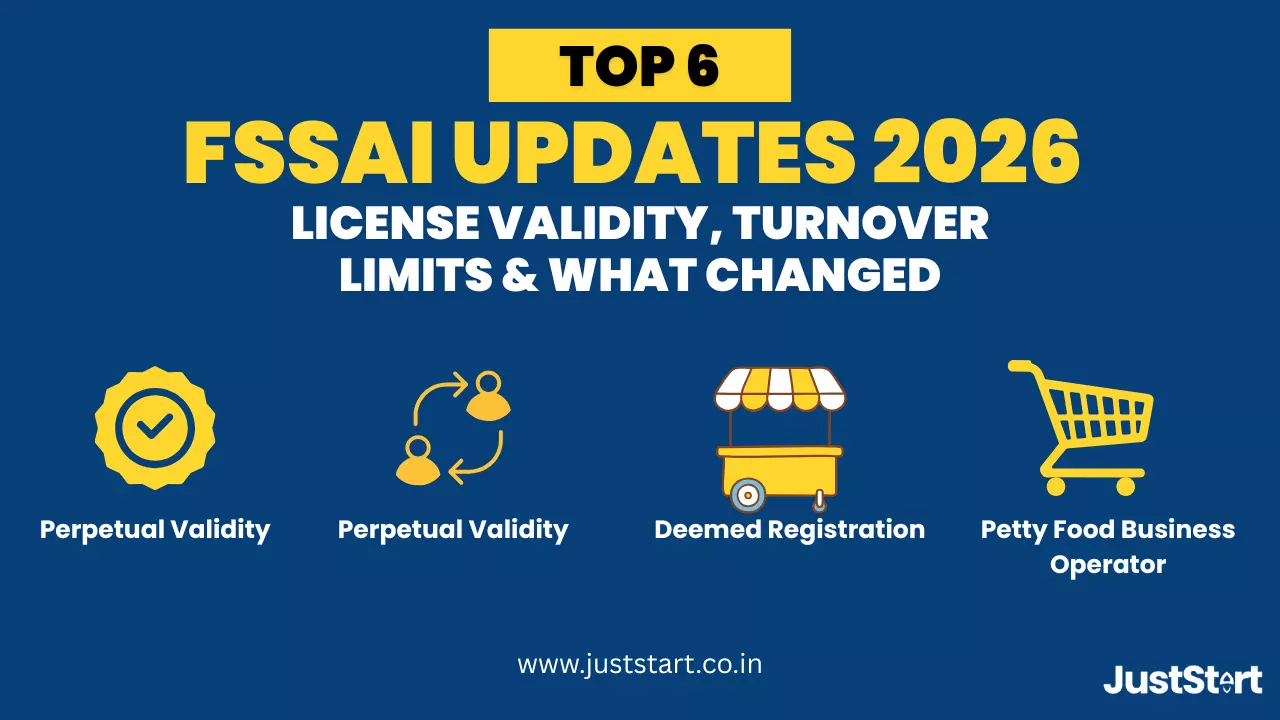
The Indian food safety authority, FSSAI (Food Safety and Standards Authority of India), has released the FSSAI amendments 2026 that bring major relief and stricter accountability for food business operators (FBOs). The new changes were notified on March 10, 2026, and came into effect on April 1, 2026. As per the updates, the license now has perpetual validity, removing the renewal headache, including a significant increase. The FBOs don't have to pay an additional amount to get the "license lifetime validity" status. Let's dive into this guide to explore the Food Safety and Standards (Licensing and Registration of Food Businesses) Amendments Regulations, 2026, including how new changes are impacting small and medium food businesses.
What Are the New Changes in 2026: At a Glance
|
|
|
|
|
|
|
|
|
|
|
|
|
|
|
|
|
|
|
|
|
|
|
|
|
|
|
|
Note: Under Regulation 2.1.7(3) of the amended rules, if FBOs close their food business and surrender their FSSAI license or registration, they don't get back any of the license fee they already paid.
Key FSSAI Amendment in 2026 for Food Businesses
The Food Safety and Standards (Licensing and Registration of Food Businesses) Amendment Regulations, 2026, highlight key changes. Every FBO that is going to start a food business or is already in this sector must implement these changes to avoid possible penalties. Here are the top 6 changes in FSSAI rules in 2026:
1- Perpetual (Lifetime) Validity of FSSAI License/Registration
To improve the renewal headache at every fixed timeline, the food FSSAI authority has made a historic change by introducing perpetual (lifetime) validity. The food business operators are often required to apply for renewal every 1 to 5 years (as per the tenure they selected and the fee paid). It means that once the food registration/license is issued, it is valid unless it is suspended, cancelled, or surrendered. What it means for you:
- No need to apply for period renewal applications.
- Existing licenses/registrations continue under the old system until they expire.
- Required to maintain annual license/registration fee compliance
- If required, file 'annual returns.'
The new FSSAI license/registration doesn’t require renewal for 1 to 5 years, but FBOs are required to pay the annual license/registration fee on time. If the required annual fee is not paid or returns are not filed before the due date, the authority suspends the license unless the pending return compliance is fulfilled.
2- New Threshold Limit for different License/Registrations
Changes in the annual turnover limits for its three compliance tiers are the biggest relief for the small and medium food businesses. Under the new threshold limit, the businesses are required to apply for the specific license/registration category. The new threshold table from April 1, 2026, follows:
|
|
|
|
|
|
|
|
|
|
|
|
|
|
|
|
Impact on the Food Businesses:
- Earlier, many food businesses were required to obtain a state license if their turnover crossed ₹12 lakh or above. But, as per the new threshold limit, they only required Basic FSSAI registration instead of a "state license."
- The FBOs whose turnover is only up to ₹50 crore or below it can remain in the "State License" category and are not necessarily required to move for a central license. From April 2026, 98% of food businesses in India will come under a state license.
- Despite the new threshold limit, there are a few businesses in the food sector that require a central or state license regardless of revenue or scale.
- Importers, exporters, e-commerce businesses, five-star hotels, multi-state operators, government premises, and specialized food require the central license regardless of their revenue.
- Regardless of total annual revenue, the mid-start hotels, caterers, and milling units are required to obtain a state license.
Importer Note: The food businesses do not need to panic if they already have an active license/registration under the old system. The FoSCoS portal automatically transitions an existing active license into a new system.
3- Deemed Registration for Street Vendors
The street vendors often required a separate FSSAI registration despite being registered with the Municipal Corporation or Town Vending Committees under the "Street Vendors Act 2014." But the FSSAI amendment regulations 2026 highlight that all street vendors, food trucks, hawkers, etc., are now treated as "deemed registered under FSSAI." What it means for you:
- The street vendors and hawkers do not need to apply for an additional application for FSSAI if they are registered under the Street Vendors Act.
- Holding a valid vending certificate means your business is automatically registered with FSSAI (Food Safety and Standards Authority of India).
- No extra fee is paid to FSSAI, and no extra application is required, significantly reducing the dual compliance burden for the small street vendors and hawkers.
4- Expanded “Petty Food Business Operator” Definition
The term “Petty Food Manufacturer” has been changed to “Petty Food Business Operator." Now, the term includes a broad category of food businesses. The eligible entities under this new definition are:
- Street food vendors, hawkers, and itinerant vendors.
- Food truck and food cart operators.
- Temporary stallholders (e.g., at fairs, melas, or markets).
- Individuals or groups distributing food at social or religious gatherings (excluding professional caterers)
- Small-scale, micro, or cottage food manufacturers.
The new “Petty Food Business Operator” definition strictly complies with the new registration framework and the “deemed registration” concept.
5- Suspension Mechanism Restricted to Fee & Returns
As per the FSSAI amendment regulations of 2026, the food license/registration will be suspended if any FBO fails to submit the annual compliance fee or does not file the return on time. The food FSSAI license/registration will be suspended unless previous compliance formalities are fulfilled. Once a license or FSSAI registration is suspended by the authority, the food business owners cannot operate until the return fee or pending payment is paid.
On Business Closure:
- If a food business decides to close its operation, it must notify the registering authority at least 30 days before the business closure in writing.
- The FBOs also must surrender their registration certificate.
- The fee is not refundable upon the food business's closure.
For example (No Fee Refund): Suppose you are an FBO of a samosa shop, and you paid ₹5,000 to the authority for the annual compliance of an FSSAI license. After 2 months, you decide to close the shop for any reason, and you further surrender your certificate to the registering authority. In this situation, FSSAI will not refund any amount from the fee you paid, ₹5,000, despite you only completing 2 months out of 12 months.
6. Risk-Based Inspection & Audit Framework
The FSSAI authority often conducts the inspection uniformly. But FSSAI rules 2026 have formally embedded a risk-based inspection and audit framework. It means the inspection authority conducts the inspection periodically based on defined risk factors.
What will the authority do during the inspection?
- During the periodic inspection, the authority ensures the nature and risk category of the food businesses. Verify whether they are handling it accurately or not.
- Check the type and scale of food businesses that are active in fields like manufacturing, storage, retail, and distribution.
- Verify the past compliance records of all registered FBOs.
In short, this new framework for the periodic inspection is designed to manage the regulatory resources for higher-risk businesses and products. The major purpose is to encourage better compliance by rewarding good track records with fewer routine checks.
Action Checklist for Food Business Operators
Go through this quick practical checklist to decide what you must do now under the new FSSAI 2026 changes:
Doubt 1. What to file if your turnover has crossed a threshold?
Solution: As a food business operator (FBO), your first step is to check the latest annual turnover. Earlier, the limit was ₹12 lakh for the FSSAI registration, but now it is up to ₹1.5 crore. But what if you already have a "State License," but your turnover is below ₹1.5 crore? Under this situation, you are required to apply for FSSAI registration to meet the new guidelines. But if your annual turnover is above ₹1.5 crore and up to ₹50 crore, then you are required to obtain the State License if you previously applied for the Central License. Overall, your license or registration requirement depends on your current annual turnover.
Doubt 2: What if my license expires before March 31, 2026?
The new FSSAI rules have been applicable from 1st April 2026. If your current license expires before or on March 31st, 2026, then you must use the older renewal process (1-5 years). The perpetual/lifetime validity shall apply only to those FBOs who have applied for a license/registration on or after April 1, 2026. If your current license expires after March 31, 2026, you’ll have to check out the new guidelines. The license will be renewed on the old system or the new perpetual/lifetime validity framework.
Doubt 3. What if you are a street vendor?
The new FSSAI changes in 2026 bring big relief for the street vendors. All street vendors, hawkers, food carts, etc., registered under the "Street Vendors Protection of Livelihood and Regulation of Street Vending Act, 2014" with your Municipal Corporation / Town Vending Committee, are treated as deemed registered under FSSAI. The rule applies from 1 April 2026. It majorly impacted the FSSAI compliance requirements. Since street vendors are treated as deemed registered, they are not required to file a separate FSSAI registration application. Including, they didn’t even have to pay any additional fee for FSSAI registration. Your street vending certificate is legally accepted for FSSAI compliance.
Conclusion
The FSSAI 2026 rules significantly simplify the compliance burden for food businesses while tightening accountability. Now, the FBOs don’t require periodic license renewal, as after March 31, 2026, they hold perpetual/lifetime validity. Furthermore, the annual threshold limit has also been increased, and the street vendors have enjoyed deemed registered status under FSSAI. Despite the new changes, the FBOs are still responsible for maintaining annual filings, hygiene parameters, and on-time annual fee submissions. Noncompliance with the FSSAI rules can trigger the possible suspension of the license/registration. But with the right guidance and support, these non-compliance burdens can be removed. To simplify the compliance burden, the experts of JustStart track every regulatory update for you and manage end-to-end FSSAI compliance formalities.
Frequently Asked Questions
Q1. Do I still need renewal for my current license?
Ans. No, you do not need to renew your food license if you received it after March 31, 2026. In case your license validity expires before March 31, 2026, then you must apply for renewal for a period of 1-5 years.
Q2. What is the new FSSAI registration limit?
Ans. As per the official FSSAI rules, the new turnover threshold limit has been increased from ₹12 lakh to ₹1.5 crore. It means the food businesses are only required to apply for FSSAI registration if their annual turnover is up to ₹1.5 crore.
Q3. What are the key reforms introduced in the FSSAI amendments of 2026?
Ans. The FSSAI food authority has made a few major changes that significantly provide relief to small and medium food business owners. The primary change in the validity of a license has been from periodic 1-5 years to perpetual/lifetime validity. The second change is in the threshold limit, which applies to all FSSAI registrations and state and central licenses. And the biggest change for the street vendors and hawkers is that they are treated as deemed registered under FSSAI, which eliminates the requirement for dual compliance.
Q4. How does "perpetual validity" help the food businesses?
Ans. The biggest relief for the authority is to avoid the periodic renewal burden. The FBOs also do not need to track the renewal deadline, which significantly prevents hefty penalties. Once a food certificate is issued, it will be valid unless it is suspended, surrendered, or blocked.
Q5. Will the license or registration number change if I change my current category from central to a state license?
Ans. No, the 1-4 digit FSSAI number will not change when you are converting your certificate category from a central to a state license. You can change your license category without worrying about changing the 14-digit number, as it will remain the same.