
Introduction
LLP registration in India is a straightforward process and is completed via the MCA portal. Before incorporating a Limited Liability Partnership (LLP) in India, you are required to fulfil the formalities governed by the Limited Liability Partnership Act, 2008. The registration of the LLP process starts with preparing the supporting documents that also include drafting the "LLP Agreement". Often, businesses face application rejection due to incomplete, mismatched, or wrong documentation. A minor mistake in documents impacts the LLP registration processing timeline, which can be extended for months. In this comprehensive guide, you will explore which documents you are required to submit to start an LLP (Limited Liability Partnership) in India and how you can avoid mistakes by following the right approach.
Documents Required for LLP Registration in India
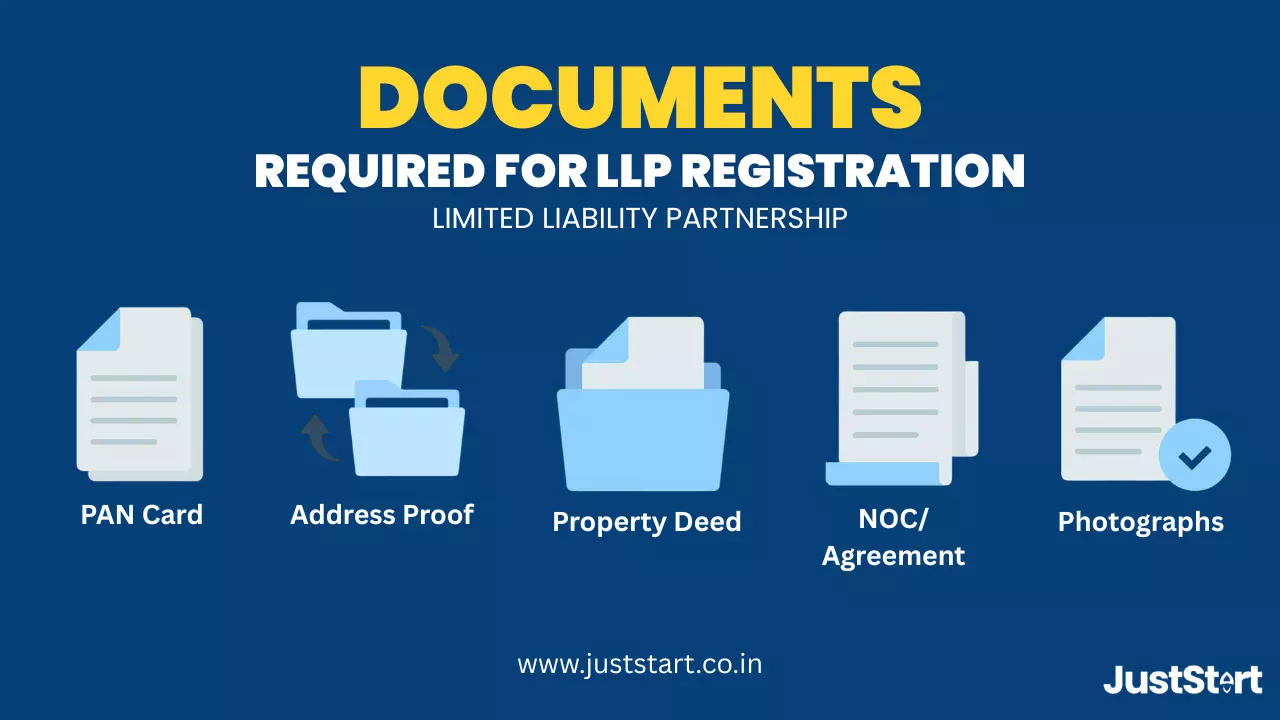
To start a Limited Liability Partnership (LLP) in India, at least two partners are required (one must reside in India). The LLP registration documents are separated into four sections, and a few certificates depend on the Indian vs NRI/foreign partners. Here is the complete checklist for documents needed for LLP registration in India:
Section 1. Documents Required for LLP Partners
The designated partners are required to provide their addresses and identity proof to the governing authority. Through it, the MCA can check the background details of all designated partners in an LLP. The documents for partners depend on whether it is an Indian or a foreign/NRI partner.
Indian Partner:
- PAN Card: The appointed designated Indian partner is required to provide a copy of the PAN as it is the primary proof of identity.
- Address Proof: For the address proof, the Indian partners can submit any one government ID, including Aadhaar card, driving license, passport, or Voter ID.
- Residence Proof: Bank statement, electricity bill, mobile bill, or telephone bill are the major documents that an Indian partners can submit. However, it is important to note that proof of residence must not be more than 2 months old.
- Passport-size Photographs: The passport-size photo must be clear and have a white background. This photo is further used for the DSC application and during incorporation to verify the partner’s visual identity.
Foreign/NRI Partners:
- Passport: For foreign nationals/NRIs, a passport is the primary identity document. To become a partner in an LLP, a foreign national must provide their passport. It must be notarized or apostilled by the partner’s issuing country's authority.
- Address Proof: To verify the residential address, you are required to provide a bank statement, residence card, or utility bill. It also should be notarized/ apostilled and self-attested. The documents should not be older than 2 months.
- Passport-size Photographs: The recent passport-size photograph must have a white background.
- Translator (If required): If any document is not in the English language, a translator must be appointed.
Section 2: Registered Office Proof
The registered office address depends on the property type. The documents by property type are categorized as:
- If Owned Property: If the founder of the LLP owns property, they are required to provide a few specific documents, such as a property deed, sale deed, or any registry documents for ownership proof. If the property is owned by the partner, they must sign an NOC (No Objection Certificate) to grant permission for operational use.
- If rented Property: For the registered office proof, the founder can submit the rent agreement/lease agreement if the property is rented. Also, a required NOC signed by the landlord, permitting the use of the property for company registration. The utility bill should be in the name of the landlord and must not be older than 2 months.
- If using a Co-working Space: If using any virtual office space or co-working setup, you must provide the allotment letter/service agreement. It is an official agreement letter between the LLP and the co-working service provider. NOC (No Objection Certificate) from the co-working space provider and the master utility bill.
Section 3: Digital Signature Certificate (DSC) & DIN/DPIN
All designated partners of an LLP (Limited Liability Partnership) are required to obtain a Class 3 DSC. As the entire LLP registration process is online via the MCA V3 portal, the designated partner is required to sign the incorporation form (FiLLiP) using their personal Class 3 DSC. For the partners, class 3 DSC is further mandatory during financial report filing (Form-8) and annual return filing (Form-11). Without it, the designated partner of the LLP cannot submit the incorporation documents.
Section 4: LLP Agreement & Incorporation Filing Documents
LLP is required to file the FiLLiP form on the MCA V3 portal as it covers multiple sections such as name reservation, address proof, and DPIN assignment. Furthermore, all designated partners are required to file Consent Form-9. It is required to ensure that partners are ready to serve their role and not disqualified under the LLP Act. Once the “Certificate of Incorporation” is issued after the FiLLiP approval, you are required to draft an “LLP Agreement”. It is mandatory to draft the LLP Agreement within 30 days of issuing the “certificate of Incorporation “. The “LLP agreement” covers the internal rules for the partners.
Important Reminder: If you fail to file the LLP Agreement within 30 days of receiving the “Certificate of Incorporation”, you will face the ₹100/per day penalty for late filing.
Conclusion
Accuracy in documentation plays a fundamental role in the LLP registration process in India. Right and in-format documents speed up the processing timeline on the MCA portal. A minor mistake, such as a name mismatch on PAN and Aadhaar or any other error, results in immediate application cancellation. Before the final submission of the FilLLiP form, you must ensure that your provided LLP registration documents are up-to-date, clear, and align with MCA's latest format rules. Your right approach before starting LLP registration makes the process faster and helps you to win the race with MCA. Still facing the trouble? JustStart, a legal service provider platform, helps businesses by assisting with documentation, including drafting an LLP agreement, filing the FiLLiP incorporation form, and managing MCA compliance formalities.
Got Doubt? Clear with FAQs!
Q1. Is PAN mandatory for LLP partners in India?
Ans. Yes, all designated partners are required to provide the PAN (Permanent Account Number) during the LLP registration, as it serves as the primary document for identity proof. The PAN of Indian partners is used during LLP incorporation form filing (FiLLiP) on the Ministry of Corporate Affairs (MCA) portal.
Q2. Can I provide the 3-month-old address proof document?
Ans. No, as per the strict MCA’s guidelines, all documents for address proof such as bank statements, utility bills, or mobile bills must not be older than 2 months. If mandatory address proof documents are 3 months old, the registry will immediately reject the LLP application form.
Q3. Is a Digital Signature Certificate (DSC) mandatory for LLP registration?
Ans. Yes, DSC is strictly mandatory during the LLP registration process. All designated partners are required to have the Class 3 DSC, which is used to sign and submit the LLP incorporation form (FiLLiP) online.
Q4. When must you file the LLP agreement?
Ans. The LLP agreement must be filed within 30 days of receiving the “Certificate of Incorporation”. It must be filed with the Registrar of Companies (ROC) on the MCA portal.
Q5. How long does it take to start an LLP (Limited Liability Partnership) in India?
Ans. It typically takes 10-15 working days for government procedures. However, the timeline can be increased if the registry authority raises queries related to documents.