

Introduction
Section 8 company registration is completely online, followed via the MCA V3 portal. The SPICe+ is used to draft the application for name reservation, Section 8 license, and for all incorporation formalities. PAN is mandatory for Indian nationals who act as director/subscriber, required to verify their identity. For residential address proof, can provide any government IDs like Aadhaar card, driving license, or voter ID. For a foreign national, the passport is the first identity document. Obtain a No Objection Certificate (NOC) from the owner permitting the use of the property. In this comprehensive guide, we’ll cover the documents required for Section 8 registration in India, how to avoid mistakes, and best practices.
What is a Section 8 Company?
A Section 8 company is a non-profit organization registered under the Companies Act of 2013. A Section 8 company registered in India is formed for charitable purposes, such as the advancement of art, culture, social welfare, sports, and education. However, profits earned by a Section 8 company are prohibited from being distributed as dividends among members. All profits earned by a non-profit organization must be used to further charitable purposes. An NGO can only legally operate with a Section 8 license, which provides legal authority to conduct charitable activities within India.
Documents Checklist for Section 8 Company
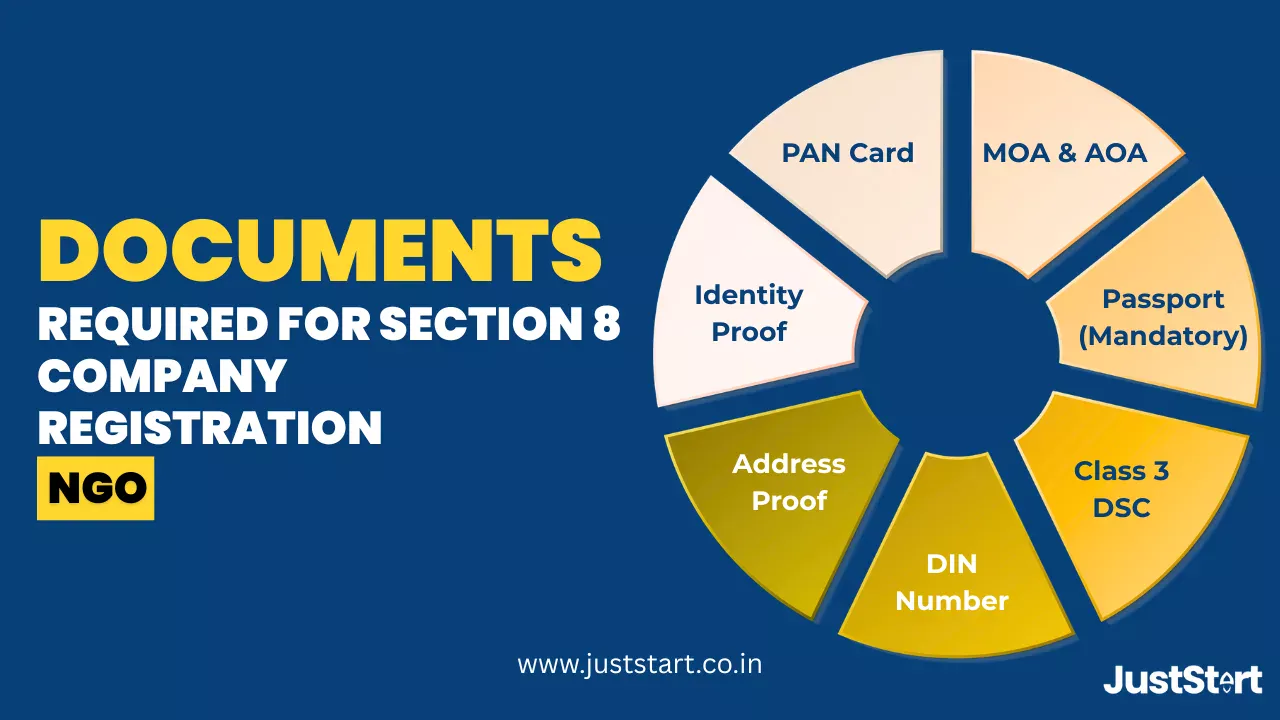
Here is the complete checklist for the Section 8 company registration documents. Look at a glance:
|
|
|
|
|
|
|
|
|
|
|
|
|
|
|
|
|
|
|
|
1. Documents Required for Directors & Subscribers
The required documents for directors and subscribers depend on the type of applicant, e.g it is an indian or an NRI/foreign national. It can be understood as:
Indian National Documents:
- PAN Card: Under Section 139A of the Income Tax Act, 1961, it is legally mandatory to use the PAN card for identity proof for an Indian applicant who wants to act as a director in a company. Particulars mentioned on the PAN must correspond with other submitted documents.
- Identity Proof: Indians must submit copies of proof of identity issued by the government. These documents include a driving license, Aadhaar card, Voter ID, or passport. MCA uses these IDs’ data to cross-verify your PAN details.
- Address Proof: The MCA verifies the physical address of the designated Indian director. For address proof, you can provide a bank statement of recent transactions, a mobile bill, a gas connection bill, or a landline bill. It must not be older than 2 months from the day of filing the SPICe+ form, and the address must match the PAN card.
- Photographs: Recent passport-size colour photograph.
- Class 3 DSC: For Section 8 company registration, only Class 3 DSC is applicable to digitally sign the e-forms on the MCA V3 portal. Indian nationals can easily apply for the Class 3 DSC by utilizing their Indian PAN and Aadhaar-based OTP/video verification.
- DIN (Director Identification Number): Foreign nationals can apply for DIN up to three times directly within the integrated company incorporation form (SPICe+ Part B) by utilizing their PAN card.
Foreign Nationals/NRI Documents:
- Passport (Mandatory): The foreign national must provide the passport, which must clearly show a photograph, date of birth, and validity. Attaching a valid date of birth certificate is crucial if it is not shown on the passport.
- Address Proof: The bank statement, electricity, water, or mobile bill are the primary documents which required to verify the address details. The bank statement must showcase the current transactions with an overseas residential address. You can provide any one of them, but they must not be older than 2 months during the Section 8 company application filing.
- Notarized/Apostilled Documents: Indian professionals cannot verify the documents of foreign nationals/NRIs unless they hold a valid certification. Therefore, all the documents must be notarized/ Apostilled of the foreign nationals / NRIs homecountry.
- DSC (Digital Signature Certificate): Foreign nationals need to have a Class 3 DSC, but they can’t apply using the Aadhaar card; instead, use the passport. Therefore, their passport is used for electronic verification.
- DIN (Director Identification Number): They can also apply for a DIN directly through the SPICe+ form. Foreign nationals can use their passport number to apply for a DIN.
Note: NRIs (Non- Resident Indians) can submit a copy of their PAN card if they have, otherwise, a passport is sufficient.
2. Registered Office Address Proof Documents
To operate the Section 8 NGO in India legally, required to submit valid registered office address proof on the Ministry of Corporate Affairs (MCA) portal. Attach these documents to SPICe+ Part B. However, the registered office documents depend on the property.
- Rented Property: If using the rented property for the NGO, you must provide a copy of the rent agreement or lease deed. The agreement must clearly mention that the owner of the property is permitted to use the property for NGO activities.
- Owned Property: If the property is owned by the director or promoter, attach the Registered Sale Deed, Title Deed, or recent property tax receipt. Furthermore, these documents must clearly showcase the name of the owner.
- Co-Working/ Virtual Office Space: A copy of the Co-working Agreement / Sub-lease Agreement. This document copy must be attached to the space provider’s letterhead.
- NOC (No Objection Certificate): Whether the property is rented or owned, providing the NOC is mandatory, and it is signed by the property owner. The NOC clearly mentions that the owner has no objection to using their property for the Section 8 company activities.
3. Company Charter Documents
The company charter documents are fundamental legal records that establish a company as an independent lawful entity. Here is the document checklist for a Section 8 company for legal records:
- MOA (Memorandum of Association): Under the Companies Act, 2013, a Section 8 company is required to draft the MOA by using the Form INC-13. The INC-13 form must clearly highlight the six clauses, such as Name, registered office, liability, capital, subscription, and object clause.
- AOA (Articles of Association): MOA is for outward activities, but AOA is required for the internal rules and regulations. The NGO is required to draft the AOA (Articles of Association), which clearly details the internal management, board powers, and non-profit rules.
- Form INC-14: The professional, such as a CA, CS, or cost accountant, verifies whether the drafted MOA and AOA are legally valid or not. The experts are required to sign the professional declaration form INC-14, which clearly mentions that MOA /AOA verified and complies with Section 8 of the Companies Act.
- Form INC-15: The subcribers/promoters of a Section 8 company are required to sign the Form INC-15 to declare that the Section 8 license is made for goods faith, and the objects are clear for charitable purposes.
- Income-Expenditure Estimate (Three-Year Projection): The governing authority will not issue the Section 8 license until you submit the financial record roadmap. Under Rule 19 (3) of the Companies (Incorporation) Act, it is mandatory to submit the projected budget plan for the next 3 financial years.
Common Reasons Why Section 8 Company Documents Get Rejected
Often, the Section 8 company documents get rejected due to incomplete or mismatched details. These errors are the biggest reason why companies face rejection, which results in a waste of money and time. But the right approach and support can help to avoid these costly mistakes. Here is the checklist of common mistakes that you may face during Section 8 company registration in India:
Mistake 1: Attach 2 Months Older Address Proof Documents
During the NGO registration process, you are required to provide the address proof documents such as a bank statement, a recent utility bill, etc. However, if it is 2 months old, the application gets rejected or requires re-application.
How to fix: Must ensure that the address proof documents, such as a utility bill, are not older than 2 months. If you attach the bank statement for the address proof, it must showcase recent transactions, which also should not be older than 2 months.
Mistake 2: Select the Wrong Name for the NGO
If you applied for the Section 8 company name approval and it gets rejected, it means the name is too generic, a copy of an existing trademark, or does not reflect the objective of the NGO.
How to Fix: Before filing the name reservation for Section 8, you must clearly verify that the name reflects the non-profit objectives, including not matching any existing company name or trademark. With the NGO name, you can add the suffix like foundation, fedrum, association, chambers, councils, etc.
Mistake 3: Name Mismatch Across Identity ID Proofs
A minor mistake in the name of the subscriber/ member of the Section 8 company results in immediate application rejection.
How to Fix: The name must be identical across government ID proofs. If Rajesh Kumar is written on the PAN card, it must also be written word-for-word on the Aadhaar card. It significantly prevents application re-submission.
Mistake 4: Failed to Draft 3-Year Financial Records
The rules for a Section 8 company are stringent, as it engages in non-profit activities. If an NGO fails to provide the financial record budget for the next-3 years, the authority will not grant the Section 8 license.
How to Fix: In the Section 8 application, the NGO is required to mention an estimated income and expenditure statement for the first three years of operations. The projection sheet must be signed by a certifying professional such as a CA/CS.
Conclusion
Section 8 company registration process is completely online and done via the MCA V3 portal. It is crucial to prepare all the documents in advance to avoid delays or rejection. The accuracy and completeness of documents required for a Section 8 company matter a lot to avoid MCA rejections/remarks. The web-designed SPICe+ form is used for filing with the licence issued alongside incorporation. Section 8 company documentation is not anymore headache for new entrepreneurs who want to invest their valuable time in charitable activities. The documentation process is much streamlined with JustStart experts who handle the preparation to file the SPICe+ form. From incorporation, GST filings, to trademark registration, Indian entrepreneurs get compliance handled by JustStart's dedicated and experienced CAs and CS team.
Frequently Asked Questions (FAQs)
Q1. How minimum number of members/directors required for a Section 8 company?
Ans. The number of members and directors depends on the Section 8 structure. If it is registered as a Private Section 8 company, it requires a minimum of 2 directors and 2 menbers/shareholders. However, if it is registered as a Public Section 8 company, required 3 directors and 7 members.
Q2. Can a NGO engage in commercial activities in 2026?
Ans. Section 8 companies can conduct commercial activities in 2026, provided the business directly aligns with their charitable causes. The governing authority only reviews how the money is handled and used. The profit earned must only be used for charitable purposes.
Q3. Can an OPC (One Person Company) become part of a Section 8 company in India?
Ans. No, under the Companies Act, 2013, a One Person Company (OPC) is strictly prohibited from incorporating, being a part of, or converting into a Section 8 company. OPC cannot legally engage in any non-profit activities with a Section 8 company.
Q4. What minimum capital is required to incorporate a Section 8 company?
Ans. There is zero minimum paid-up capital required to incorporate a Section 8 company in India. Depending on initial financial needs, It also can start with ₹1000 or even less.
Q5. How long does it take to start a Section 8 company (NGO)?
Ans. The Section 8 company registration process is completely online and done via the MCA V3 portal. The government procedure takes 15-20 working days or can be extended if the authority raises queries.