

Introduction
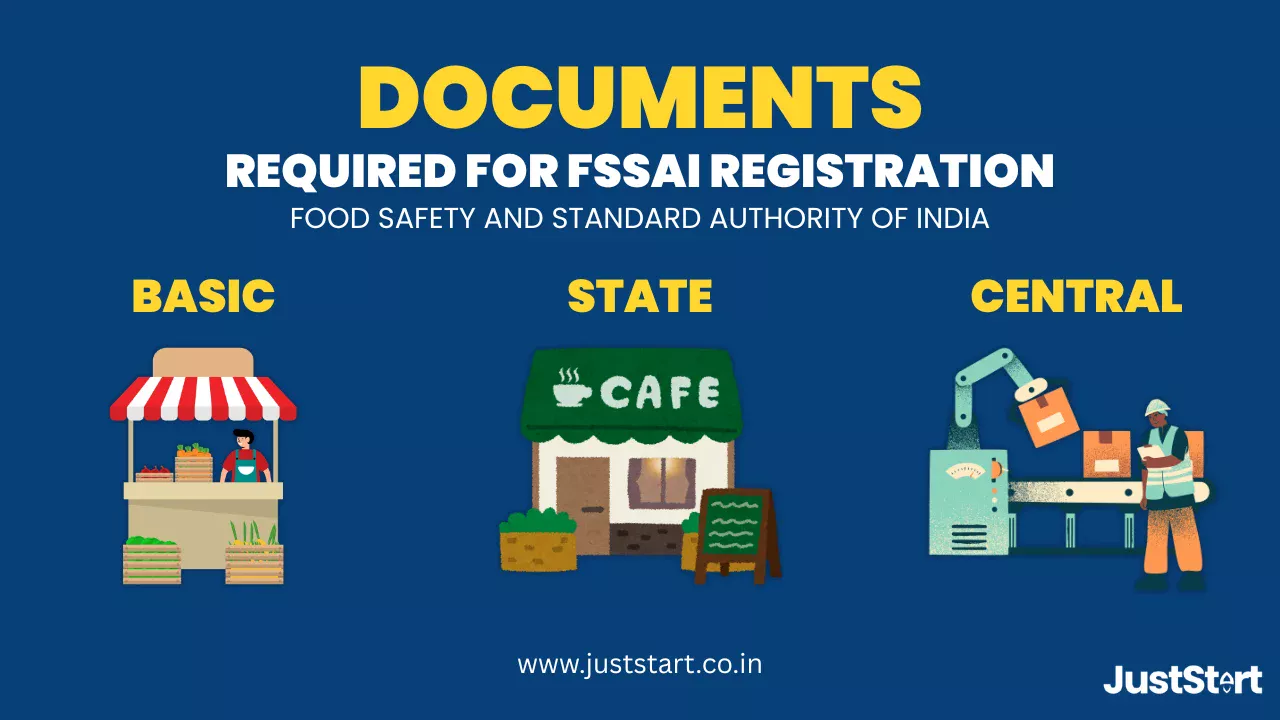
The number of documents required for FSSAI registration depends on the basic/state/central category. Documents required for basic registration include proof of address and identity, such as the applicant's photograph, a signed declaration form, etc., and are submitted on the FoSCoS portal. The state or central FSSAI license is for larger food businesses, and they are required to provide additional documents like Form B, site plan, complete equipment list, NABL-accredited laboratory test report, etc. However, incomplete or incorrect documents trigger immediate application rejection. Let's dive into this guide to explore what documents are required for FSSAI registration, how to prepare them, and what the common reasons are for food FSSAI application rejection.
What is FSSAI Registration?
FSSAI registration (also referred to as food registration) is an authorization issued by the Food Safety and Standards Authority of India. Any individual or company associated with food manufacturing, packaging, processing, storing, transporting, or selling of food products in India is required to register with the FSSAI authority. Once registration or a license is issued, the food business owners get the authorization to operate their food business lawfully.
The valid food certificate indicates that the food handled by the businesses meets all safety and hygiene standards under Food and Safety Standard Act, 2006. The FSSAI registration is categorized into three parts, depending on the size of the business and turnover.
Types of FSSAI Registration in India
Which food certificate you are required to obtain depends on your turnover and business size. There are three FSSAI registrations: Basic registration, state license, and central license. Go through the table to know which certificate you are required to obtain as per your turnover limit:
|
|
|
|
|
|
|
|
|
|
|
|
|
|
|
|
Documents Required for FSSAI Basic Registration
Address proof, identity proof, photographs, and complete Form A are the major documents required during FSSAI basic registration on the FoSCoC portal. Here is the complete checklist of FSSAI basic registration documents:
- Identity Proof: The applicant is required to provide identity proof documents such as PAN card, Aadhaar card, voter ID, passport, or driving license. Must provide any one document in an accurate format.
- Address Proof: If the food business property is rented, attach a copy of the rent/lease agreement; if the property is owned, attach a copy of the sale deed.Property tax receipt. Additional documents are an NOC (No Objection Certificate) and a utility bill.
- Photographs: Clear and recent photographs of applicant/food business owner.
- Application Form A: Duly completed FSSAI food registration application form. It must be filed on the FoSCoS portal.
- Food Product List: A complete list of the products you intend to sell or pack.
- NOC/ local body certificate (If applicable): NOC from the local municipality or panchayat.
- Additional Documents: If you are operating as a registered entity, you are further required to provide the additional documents related to the incorporation certificate.
Documents Required for FSSAI State License
Form B is filed to obtain the state license for a food business in India, and the application is registered on the FoSCoS portal. A state license is obtained by the larger food businesses whose turnover falls between ₹1.5 crore and ₹50 crore. Here is the complete checklist of FSSAI state license documents:
- Form B: The application Form B must be duly completed and signed by the proprietor, partner, or authorized signatory.
- Identity Proof: To provide the identification proof, attach a copy of any one: PAN card, Aadhaar card, driving license, passport, or voter ID.
- Address Proof: If the business property is rented, provide the lease agreement and, if the property is owned, please provide the sale deed. Tax payment is another requirement. You are also required to submit an NOC (No Objection Certificate) and copies of utility bills.
- Registered Entity Proof: According to your registered company, provide constitution proof. If registered as private limited/public limited, provide the Certificate of Incorporation. For a partnership firm, required Partnership deed.
- Facility Layout & Items List: Complete drawing of facility showcasing the dimensions in meters and operational zoning (required for manufacturing and processing). Further, make the complete list of the food items, including machinery or any other tool used.
- Details of Supervisor: Complete details of the person who is supervising the production (qualifications including degree in the relevant field).
- Category-Specific Document: As per your food business type, attach the other required documents. For example, if an FBO builds a five-star hotel and handles food items, provide the HRACC certificate issued by the Ministry of Tourism. Other documents further related to caterers, restaurants, dairy units, meat processing units, transporters, etc.
Documents Required for FSSAI Central License
FSSAI central license is only issued to companies that import/export or manage the food business on a larger scale. Furthermore, to apply for a food central license on the FoSCoS portal, the applicant is required to provide comprehensive operational and safety documents. FSSAI central license documents checklist is as follows:-
- Form B: Must be a duly completed and signed application form (filed on the FoSCoS form).
- Identity Proof: The identification proof of the applicant/owner. Provide any one copy among PAN card, Aadhaar card, driving license, or voter ID.
- Business Registration Proof: If your food business is registered on the MCA (Ministry of Corporate Affairs) portal under any entity structure, provide the relevant document. If registered as private limited/public limited, provide the Certificate of Incorporation.
- List of Directors/Partners: If your food business company is legally registered, attach the complete details like identity, address, and other relevant information.
- Address Proof: The utility bill (electricity bill, water bill, gas bill, or any relevant bill), including an NOC from the property owner. If the property is rented, provide a lease/rent agreement; if owned, attach a copy of the sale deed or property tax receipt.
- Board Resolution: Authorizes a person who is responsible for maintaining annual compliance.
- Facility Layout Plan: Complete drawing of all dimensions in meters, showing the equipment placement, workflow, and other necessary operational zones.
- Technical & Safety Provisions: When working in food production, you need to get different types of documents such as an NABL water test report, machine and equipment lists, a Food Safety Management System plan, and various other food category documents.
- Import/Export-Related Documents: In case of relevance, get an IEC (Import-Export Code) and also approval from the Ministry of Commerce in terms of export-oriented units, registration for the importers, and other relevant data.
- Turnover Proof/ CA Certificate: You need to provide proof of turnover as discussed below along with the audited financial statement or CA's document confirming turnover in a document format.
Documents Format and Submission Guidelines of FSSAI
Before submitting any documents on FoSCoS, one has to first check that all documents are in the correct document format. It also makes the submitted documents error-free. The document format is as follows:
- Although JPEG and PNG files are also permitted, multi-page publications must be submitted in PDF format.
- The size of the documents must be under 1 MB per uploaded file.
- All documents must be scanned in high resolution. If any document is cut or blurred, the portal rejects the application or raises queries.
- All documents must be self-attested by the applicant, as unattested documents result in immediate rejection.
- The address mentioned on the FoSCoS portal must match word-for-word and letter-for-letter the premises proof.
- The utility bill shouldn't be more than three months old. Additionally, on the application date, the lease or rent must still be valid for at least six months.
Did You Know: The FSSAI license is no longer required to renew, as it is now valid for life unless suspended, revoked, or voluntarily cancelled. For more FSSAI updates 2026, visit our blog section.
What Are the Common Reasons for Document Rejection?
Often documents get rejected while applying for the FSSAI registration on the FoSCoS portal. Procedural errors or document mismatches are the common reasons for FSSAI form application rejection. These are the major mistakes you may face during the registration process:
-
Address Mismatch
The food processing authority rejects the application or raises queries if the address mentioned in the application does not match the address mentioned in the government IDs and other documents. Must ensure the spelling of the address mentioned in the application aligns with the uploaded proof.
-
NOC (No Objection Certificate) Missing
With a lease or rent agreement, you are required to submit the NOC (No Objection Certificate), signed by the property owner. If the NOC is not attached to the other core documents, then the Food and Safety Standards Authority of India raises queries. Must ensure you attach all documents before final submission.
-
Expired/Outdated Documents
The portal rejects the application or delays submission if you submit the utility bill (water bill, gas bill or electricity bill) older than 2-3 months. Must ensure that the ;documents are not older than the specified timeline.
-
Incorrect Format
If the documents are blurry, corp, or low resolution, mark them as invalid, and the FoSCoS portal will not accept them. Even if the file size exceeds the prescribed file size submission ratio, mark it as invalid.
-
Select Wrong License Tier
One of the biggest mistakes often made by food businesses is selecting the wrong FSSAI registration. Applying for the basic registration instead of a state license or a central license, or vice versa, causes application rejection due to wrong turnover calculation.
Conclusion
Whether the Food Business Owners (FBOs) are operating a small food business or going to build a larger hotel, obtaining the FSSAI license is crucial to meet the safety and hygiene standards. Once a turnover limit is crossed, the businesses are required to apply for the FSSAI basic registration, state registration, or central registration, vice versa. Though having a license can be a compulsory requirement of food operations irrespective of the sales volume in case of e-commerce platforms (e.g., Swiggy or Zomato), food import-export activity, or manufacture of sensitive food products (e.g., supplements, named drinking water, infant foods, etc.).
It is essential to ensure that all documents uploaded on the FoSCoS portal are ready in a proper form and with details being uniform across all the documents before applying for the license. JustStart offers businesses assistance in registration, paperwork, and annual compliance formalities, which makes the arrangement of the FSSAI registration much easier and faster.
Frequently Asked Questions (FAQs)
Q1. What documents are required for FSSAI basic registration?
Ans. There are a few specific documents needed for the application for basic registration with FSSAI, such as identity proof and address proof of the individual, recent photographs, a filled and signed Form A, a list of food products, and a declaration form.
Q2. Is GST registration mandatory for a food business?
Ans. Not directly mandatory to have a GST certificate. However, GST registration is mandatory when your food business hits the threshold limit of ₹40 lakhs for food goods only (₹20 lakhs in special category states) and ₹20 lakh for food services (₹10 lakh in special category states). Further, GSTIN is strictly mandatory if operating a food business online via food business platforms (Swiggy or Zomato) and if you operate interstate supply.
Q3. What is the validity of an FSSAI state license?
Ans. FSSAI state license issued on or after 1st April 2026 will be valid permanently and will remain in effect until revoked, suspended, or cancelled. However, depending on the tenure chosen, permits granted before April 1st, 2026 will be valid for a specific amount of time, ranging from one to five years.
Q4. What is the cost of FSSAI basic registration?
Ans. The government cost for FSSAI basic registration is ₹100 per year. The additional cost is associated with receiving the professional services (cost ranges between ₹500 and ₹2,500).
Q5. Should I apply for an FSSAI license if my turnover is below ₹1.5 crore?
Ans. If your turnover is below ₹1.5 crore, then you should apply for the FSSAI basic registration. Even if you are applying for the food license is further mandatory regardless of turnover if you sell via food business platforms, import/export food items, operate multi-state operations, or manufacture high-risk items.