

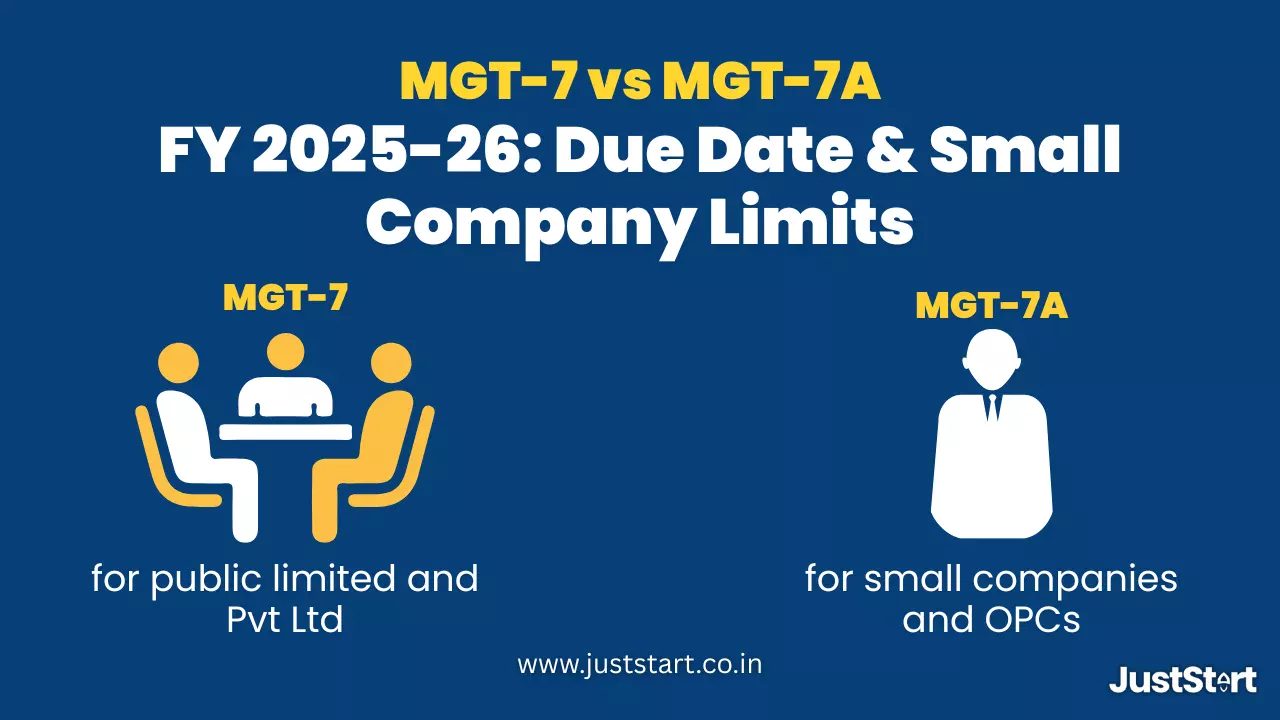
Regardless of whether it is a private limited company or a small business in India, compliance with the ROC annual return procedures is mandatory. As per Section 92 of the Companies Act, 2013, registered entities need to submit MGT-7 and MGT-7A to the Registrar of Companies (ROC). MGT-7 must be filed within 60 days of the AGM, while MGT-7A must be submitted within 60 days of the planned AGM date for OPCs. In financial filings, the entity is generally required to report its profits and balance sheets, where in MGT-7/MGT-7A form covers the operational, management, and governance details.
Form MGT-7 is a standard annual return which filed by all public companies, listed companies, Section 8 (non-profit) entities, and large private limited companies, whereas Form MGT-7A is only applicable to One Person Companies (OPCs) and Small Companies. Let’s explore the guide for the MGT-7 and MGT-7A due dates, what the penalties are, and how to file online.
What is the MGT-7 / MGT-7A Form?
MGT-7 and MGT-7A are electronic annual returns submitted by firms which are registered as per the provisions of Section 92 of the Companies Act, 2013. These forms are generally filed after filing AOC-4 (financial statements) with the ROC (Registrar of Companies). This annual return (MGT-7/MGT-7A) gives a snapshot of the company’s legal, operational, and ownership details. In a more detailed version:
Form MGT-7 (Standard Annual Return)
Filing the MGT-7 form is compulsory for all Indian companies registered under the Companies Act, 2013, like public companies, listed companies, Section 8 (non-profit) entities, and large private limited companies. However, entities who registered as small companies or OPC (One Person Company) do not qualify for this standard annual return filing. Filing of this standard form MGT-7 requires firms to conduct the mandatory AGM. Another compulsory requirement is that the qualified entities must have their return certified by a practicing Company Secretary (CS) via Form MGT-8.
Form MGT-7A (Abridged Annual Return)
MGT-7A form filing is not applicable to all types of companies, as it is limited to small companies and OPCs. This means the annual return is exclusively designed for small entities and One Person Companies (OPCs). It is the simplified version of the standard annual return, as it significantly reduces the administrative burden for the applicable companies. Further, this form doesn’t require certification by a CS.
MGT-7 vs MGT-7A: Who Files Which?
Whether a company is required to file the MGT-7 or MGT-7A, it totally depends on its annual turnover, paid-up capital, and company legal structure. Here is a complete guide on which form your company must file:
|
|
|
|
|
|
|
|
|
|
|
|
|
|
|
|
|
|
|
|
|
|
|
|
Did You Know: The Ministry of Corporate Affairs (MCA) raised the “small company” threshold, effective December 1, 2025. The paid-up capital increased from ₹4 crore to ₹10 crore, and the turnover limit increased from ₹40 crore to ₹100 crore. To qualify as a “small company” for filing the MGT-7A, entities must meet both conditions.
MGT-7 and MGT-7A Due Date for FY 2025-26
Filing of form MGT-7 is compulsory after holding the AGM. But OPCs are not required to hold the AGM. Meanwhile, the due date depends entirely on when the AGM was held.
- MGT-7 Form Submission: The filing process for the form must commence within 60 days after the AGM (Annual General Meeting). Given that the AGM is presumed to have taken place on September 30, 2026, the due date of the MGT-7 form should be November 29, 2026.
- MGT-7A Form Submission for Small Companies: Small companies are also obliged to submit the annual returns form within 60 days after the AGM. So, if the AGM is presumed to have been held on September 30, 2026, for FY 2025-26, the due date is November 29, 2026.
- MGT-7A Form Submission for OPCs: Organizations that register as OPCs (One Person Companies) don’t require having an AGM (Annual General Meeting). However, it is necessary to fill out the form within 60 days of the date of the deemed AGM. Therefore, assuming that the deemed AGM is September 30, 2026, the due date for filing the form is November 29, 2026.
How to File MGT-7/MGT-7A on MCA V3 Portal?
The annual return form is filed on the MCA V3 portal after holding the AGM (Annual General Meeting). Follow this step-by-step guide to file online:
Step 1: Navigate the MCA V3 Portal
Log in to the MCA V3 portal and register as a business user. Your credentials must be linked to the director, company secretary, or representative.
Step 2: Select Annual Return Form
Navigate to the “MCA Services” section, then “Company e-Filing,” and lastly “Annual Filings e-Forms”. Select the right form according to the business category. Select either MGT-7 (for large & public companies) or MGT-7A (for small companies and OPCs).
Step 3: Verify Auto-Filled Details
After selecting the applicable annual return form, enter the company’s CIN (Corporate Identification Number). Select the relevant financial year and cross-check the pre-filled company details.
Step 4: Mention the Required Details
In the web form section, the entity is required to mention the specific information and data files. For the bulk data, you can use the MCA Excel utility. These specific details include AGM details, shareholding structure & members list, share capital, directors & KMPs, etc.
Step 5: Attach the Supporting Documents
The documents required for the filing of MGT-7/ MGT-7A, must be updated and in PDF format. If filing the MGT-7 form (annual return), then it is mandatory to attach Form MGT-8 (certification by CS) with other papers.
Step 6: Download PDF, Sign With DSC & Upload
Upon successful pre-scrunity procedure, download the system-generated PDF. On the portal, link the DSC (Digital Signature Certificate) of the company director and the CS/PCS. Sign the PDF and re-upload it on the portal.
Step7: Pay Fee & SRN Generation
Pay the statutory ROC annual filing fee online via the online payment gateway. The system will generate the SRN (Service Request Number) and payment challan, which you can download for company records.
Documents Required for Filing of MGT-7/MGT-7A
To file the annual return with the ROC (Registrar of Companies) on the MCA V3 portal, you are generally required to attach the specific governance, financial, and operational records. These are the common documents and information you are required to attach:
- Shareholder List: Complete details of shareholders and debenture holders. It must be in a downloadable MCA Excel macro-enabled template or CSV file format.
- Registered Office Photo: Photograph of the registered office outer environment which clearly showcases the address, company’s name, and CIN. This photograph must be in PDF or JPG/JPEG format.
- Signboard Compliance details: As per Section 12, the details of the signboard are required, which must be in English and the local language.
- AGM Extension Approval Letter (If Applicable): Mandatory to get extra time to hold the AGM beyond the original due date; a scanned copy of the ROC approval letter.
- Form MGT-8 (Secretarial Certificate): Required only for the MGT-7 form, which is verified by CS.
What Are the Penalties for Late or Non-Filing?
Filing the MGT-7/MGT-7A (Annual return) is a mandatory compliance formality. Failure to file it on time or to avoid filing the form results in strict action by the ROC. The consequences for non-compliance with filing include:
1. MCA Late Filing Fee
Under the Companies (Registration Offices and Fees) Rules, the MCA charges ₹100 per day of delay from the due date. No upper cap; it is charged until the annual return form is filed.
2. Statutory Non-Filing Penalty
Under Section 92(5), Companies Act, 2013, the offender faces a fee of up to ₹10,000 base + ₹100 per day for continuing the default. Even officers of the entity also face the same penalty if the default continues. It is capped at ₹2,00,000 for a company and ₹50,000 for an officer in default.
3. Penalty for not holding AGM
If the company fails to hold the mandatory AGM (Annual General Meeting), charged ₹1,00,000 plus ₹5,000 per day for continued default. The maximum cap is calculated based on ROC adjudication under Section 99 of the Companies Act, 2013.
Conclusion
Missing the annual return due date is one of the common mistakes made by small and medium-sized businesses. For this, the authority is not charged for up to a specific amount; instead, the penalty continues unless the form is filed. But no need to worry, as JustStart experts handle the complete MGT-7/MGT-7A compliance burden. From document preparation to filing on the MCA V3 portal, everything is in one place. For any queries, visit the JustStart official portal.
Frequently Asked Questions (FAQs)
Q1. What is the due date for MGT-7 for FY 2025-26?
Ans. The due date depends on when the company holds its Annual General Meeting (AGM). The MGT-7 form for FY 2025-26 must be filed within 60 days of the AGM.
Q2. What is the difference between MGT-7 and MGT-7A?
Ans. Both forms are used for annual return filing, but MGT-7 is filed by all companies except OPCs and small companies. However, MGT-7A is specially designed for OPCs and small companies.
Q3. Who is required to file MGT-7A instead of MGT-7?
Ans. The entities who registered as a One Person Company (OPC) and categorized as a small company under specific provisions are required to file MGT-7A instead of MGT-7.
Q4. What is the penalty for late filing of MGT-7 or MGT-7A?
Ans. If any entity fails to file the annual return form before its due date, it triggers a penalty of ₹ 100 per day with no upper cap.
Q5. Is there a maximum cap on the MGT-7 late fee?
Ans. No, there is no maxim cap on the late fee for MGT-7 filing. The penalty continues until the form is filed.