
Introduction
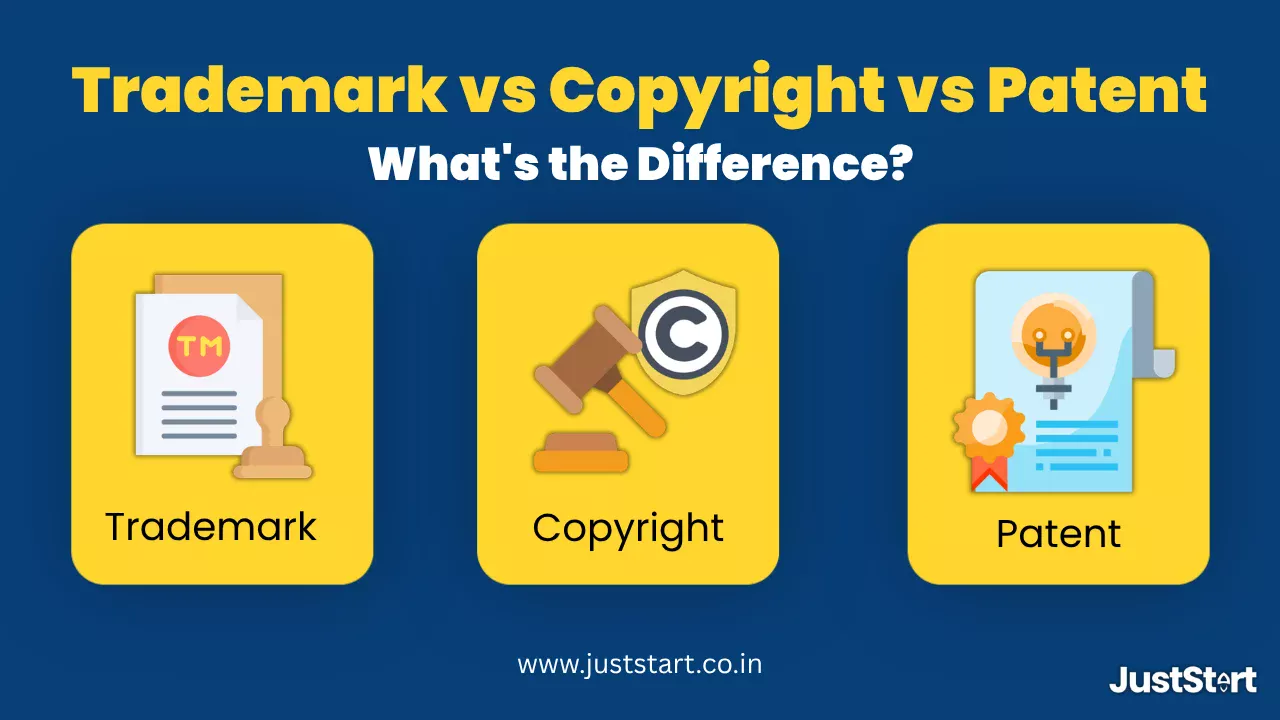
You build up a business under a particular brand name, make the text for your site, and perhaps create a process. How can you protect your brand name and innovative creation so that no one can use it legally? You need the law of intellectual property rights against infringement. In what way does it make sense to opt for the trademark vs. patent vs. copyright? The importance of intellectual property is huge as it relates to every creative action taken. The founders of the companies often confuse the terms trademark, patent, and copyright.
To make the difference easier to picture, take a single example and carry it through this guide: a startup called "NutriBox" that builds a nutrition-tracking app. The brand name "NutriBox" and its logo need a trademark. The app's user interface, its underlying code, and the blog content on its website need copyright. And if NutriBox has built a genuinely novel food-scanning algorithm that no one else uses, that invention needs a patent. Keep this one example in mind as you read through each section below; it's the same product, just three different assets within it, each needing a different kind of protection.
Trademark vs Copyright vs Patent: Comparison checklist
Here is the core difference between patent, copyright, and trademark. Look at a glance:
|
|
|
|
|
|
|
|
|
|
|
|
|
|
|
|
|
|
|
|
|
|
|
|
|
|
|
|
|
|
|
|
|
|
|
|
|
|
|
|
|
|
|
|
|
Worth flagging on that trademark timeline: a lot of guides still quote the older 12-month estimate, but with the current filing backlog, 2026 applications are realistically taking closer to the upper end of that 6-18 month range.
What is a Trademark?
A trademark is intellectual property that protects the words, names, symbols, or logos that help the general public recognize the goods or services of a specific brand. It further helps to separate a brand from competitors in competitive markets where similar name brands or logos are available. In short, a trademark protects the identity of a brand lawfully. Under the Trade Marks Act, 1999, the law provides the legal rights to the owner to take action against others who are using the same or similar mark. Going back to our NutriBox example, the name "NutriBox" and its logo are exactly the kind of assets this protects; they're what customers recognize the app by, and a trademark stops a competitor from launching a lookalike app under a confusingly similar name.
What is a Patent?
A patent is an exclusive legal right that an inventor gets for their innovation. Meanwhile, it is issued by the government to the inventor. One of the main goals of registering a patent is to prevent others from producing, utilizing, distributing, or importing an invention without the authorization of the true inventor. For the invention to be allowed for registration, it has to be innovative, imaginative, beneficial, or useful for various purposes. Additionally, a patent has to be submitted to the Indian Patent Office. Patents in India are valid for 20 years from the date of filing. For NutriBox, this would cover the actual food-scanning algorithm itself, not the app, not the branding, but the underlying technical method, if it's genuinely novel and not something already in use elsewhere.
What is a Copyright?
Copyright in India is administered under the Copyright Act of 1957 and the Copyright Rules of 2013. Through registration, individuals get the rights over how their original work is used, copied, or broadcast. However, the individual gets automatic copyright protection when a work is created. But registration provides legal rights and access to various benefits. In court, during an objection, a registered copyright serves as "prima facie evidence".
There's an important nuance worth knowing here: even if a copyright is later sold or transferred to someone else, the original creator doesn't lose everything. Under Section 57 of the Copyright Act, authors retain what's called "moral rights": the right to be credited as the creator, and the right to object if the work is distorted or altered in a way that damages their reputation. So if NutriBox's app UI was designed by a freelance designer who later assigns the copyright to the company, that designer can still insist on being credited and can object to the design being mutilated beyond recognition; this right survives the transfer itself.
Did You Know: What is a Trade Secret?
A "Trade Secret" is another form of intellectual property protection that acts as a valuable business secret that a company keeps hidden from the public to stay ahead of its competitors. Trade secret generally protects the process, formulas, and customer list. To be accounted for as a trade secret, companies are required to meet the three basic rules, including:
- The process and formula must be secret, and only a few people in the company know it.
- It gives the business a financial advantage over rivals.
- The owner takes the right step to protect their process or formula with a strong password or a locked vault.
Which One Does Your Business Need?
The registration for a trademark, patent, or copyright depends entirely on the applicant and the asset they want to protect. Often, the larger companies use a combination of these, depending on their specific assets. But which one does your business need? Here is the complete checklist to know which intellectual property protection is required for your business:
Trademark
You must trademark your brand name, logo, slogan, or any mark that you want to protect from unauthorized use. The trademark is governed by the Trade Marks Act, 1999, and the Trade Mark Rules, 2017, which control the registration, protection, and enforcement. If you are operating as a commercial business, then trademark registration is an ideal choice for you. The trademark provides the exclusive legal rights to the owner for stoping the others to copy their brand name, logo, or slogan that sounds like theirs.
Copyright
Copyright is ideal for writers, coders, artists, and media creators. At the time of the creation of a work, copyright protection comes into existence. In those cases where digital content is created, articles are written, a website is built, or a special application is developed, the copyright needs to be registered. The copyright lasts for the lifetime of the creator plus 60 years until it becomes a part of the public domain.
Patent
Patent registration is mandatory, unlike copyright or trademark, as the tech innovations or any inventor's assets must be patented to keep them protected. The patent generally protects the brand-new machine, physical inventions, new formulas for innovations, etc. The patent generally lasts for 20 years from the date of filing.
If budget is tight and you can only prioritize one to start with, trademark registration is usually the right first move for most early-stage businesses. Your brand name and logo are typically the first assets that start building recognition and goodwill in the market, so protecting that identity early tends to matter more, sooner, than locking down copyright or patent rights; those can usually follow once the business has more to protect and more room in the budget.
How to Register: Trademark vs Copyright vs Patent
Trademark, copyright, and patent protect different assets and have different filing portals. Follow these steps to file any intellectual property according to your needs for assets.
How to Register a Trademark?
- Search Trademark: To avoid rejection, check if your logo or brand name is already trademarked under NICE Classification (1-45).
- Filing Application: Submit the required application form TM-A and further attach the other supporting documents, including identity proof, address proof, and other alternative certificates.
- Examination: The submitted application and document information are verified by the trademark officer. If any query is raised by the officer, then the applicant is required to reply within 30 days.
- Publication: To invite third parties, the approved mark or logo is advertised in the Trademark Journal for four months.
- Certificate Issuance: If an objection is not raised by the third party, the registry issues the registration certificate. Once the mark or logo is registered on the government portal, you can use the symbol ® on any of your products or services.
How to Register for Copyright?
- Make an Account & Fill Application: Visit the official "Copyright Office Portal". Log in with your credentials by clicking on "New User Registration". File the application Form XIV and mention the details of the author, title, language, and the publication status.
- Upload Your Work: Attach your original work in an accurate format. If your original work belongs to the literary/software/music category, you must upload it in PDF format. JPG/PNG is ideal for art, and MP3 for sound. Ensure that all uploaded documents are under 10 MB.
- Pay Fee for Copyright: Pay the Copyright registration fee by using the prescribed payment gateway. Once the payment is completed, you will get a Diary Number.
- Print & Post: Print the generated copyright form as well as the payment acknowledgement receipt. Within 30 days, you are required to mail the printout along with the physical copy of your original work.
- Examination and Issuance: There is 30 days waiting period for objections. If no queries are raised, the examination will be conducted, and the registration certificate will be issued.
How to Register for a Patent?
- Search Patent & Draft Specification: Use the existing local and global databases to check whether your invention is non-obvious or novel. Use Form 2 to describe the invention, claims, and abstract.
- File the Application: Make an account on the IP India e-filing portal and file the respective forms such as Forms 1, 2, 3, and 5. With these forms, further attach the required documents.
- Pay the Fees: Pay the patent registration fees via any payment gateway. The general cost for a patent ranges between 1,600 (for individuals and small cooperatives) and 8,000 (for larger entities).
- Publication & Examination: The application is automatically published by the official patent office after 18 months. However, if you file Form 9 for expedited processing, the application will be published early, within 1 month. For the examination, you are required to file Form 18; then the IPO will examine your patent application.
Note: In case you are a startup, an MSME, or a female applicant, you can file the Form-18A for expedited examination.
- Respond to First Examination Report (FER): If the First Examination Report raises objections, it is sent to the applicant. You need to file a written response in the form of a letter detailing the objections within six months. In case you want fast processing, a finished Form 4 will be required within three months.
- Patent Certificate Issuance: When all the objections are resolved, the Patent Controller Authority will approve the application and issue the patent certificate.
Not Sure Which IP Protection You Need?
Protect your brand, content, or invention before someone else does.
JustStart handles trademark filing, copyright registration, and objection responses end to end — so your IP is secured, not just filed.
Conclusion
Whether you want to register for a trademark, copyright, or patent, it entirely depends on the assets that you want to protect. All intellectual property use protects your original assets from copycats and unauthorized use. Small to medium businesses or individuals require only one among trademark, patent, or copyright; however, larger businesses with high public recognition apply for all these to ensure no one copies their brand logo, uses their creative original work, and protect from stealing the invention. However, once a mistake is made during the registration process, the application. But the right guidance and support can improve the filing process. That's where Juststart helps the business with trademark filing, managing objections, and drafting objection files, including handling the copyright registration.
Frequently Asked Questions (FAQs)
Q1. Is Trademark Registration Compulsory in India?
Ans. No, there is no legal requirement to register any trademark in India for starting a business or any brand name. However, the Trade Marks Act, 1999 provides legal rights to the owner to take action against the copycats in the form of trademark registration.
Q2. Do I need to register a copyright, or is it automatic?
Ans. The copyright protection is completely automatic. The creator gets copyright protection the moment the original work is created and saved in tangible form. Whereas copyright registration provides the exclusive rights to stop others from using your original work.
Q3. Can I trademark and copyright the same logo?
Ans. Yes, you can protect the same logo with both copyright and trademark registration. But both trademark and copyright serve different roles for a particular logo.
Q4. What is the validity of a trademark in India?
Ans. A trademark is generally valid for 10 years from the date of original filing.
Q5. What if I don't register my patent before disclosing my invention?
Ans. Your disclosure is prior art and can permanently destroy ownership if you disclose your invention prior to filing the patent for it.
Q6. What's the difference between ™ and ®?
Ans. The ™ trademark symbol is for an unregistered brand name or logo. ® registered trademark symbol is the official mark that shows your unique logo or brand name is officially registered with the government.
Q7. Can a startup afford all three types of protection?
Ans. Yes, startups can afford all three at once or on a full international scope. Copyright is entirely free and secure during the creation of the original work. Whereas a trademark is moderately priced and a patent is expensive.
Q8. How to apply for a patent in India online?
Ans. Patent registration in India is completely online, and register on the Indian Patent Office e-Filing Gateway.
Q9. What documents are required for copyright registration?
Ans. The documents required for copyright registration include information about the applicant, work details, business proof, valid proof or copies of the original work, a No Objection Certificate (NOC), and other legal certificates.
Q10. Is copyright registration free?
Ans. No, copyright registration is not free, required to pay the statutory fee. You get copyright protection the moment the original work is created.
Q11. Does copyright transfer to a buyer remove the original creator's rights entirely?
Ans. Not entirely. Even after a copyright is sold or assigned, the original author retains "moral rights" under Section 57 of the Copyright Act, the right to be credited as the creator and to object if the work is later distorted or altered in a damaging way.