

Introduction
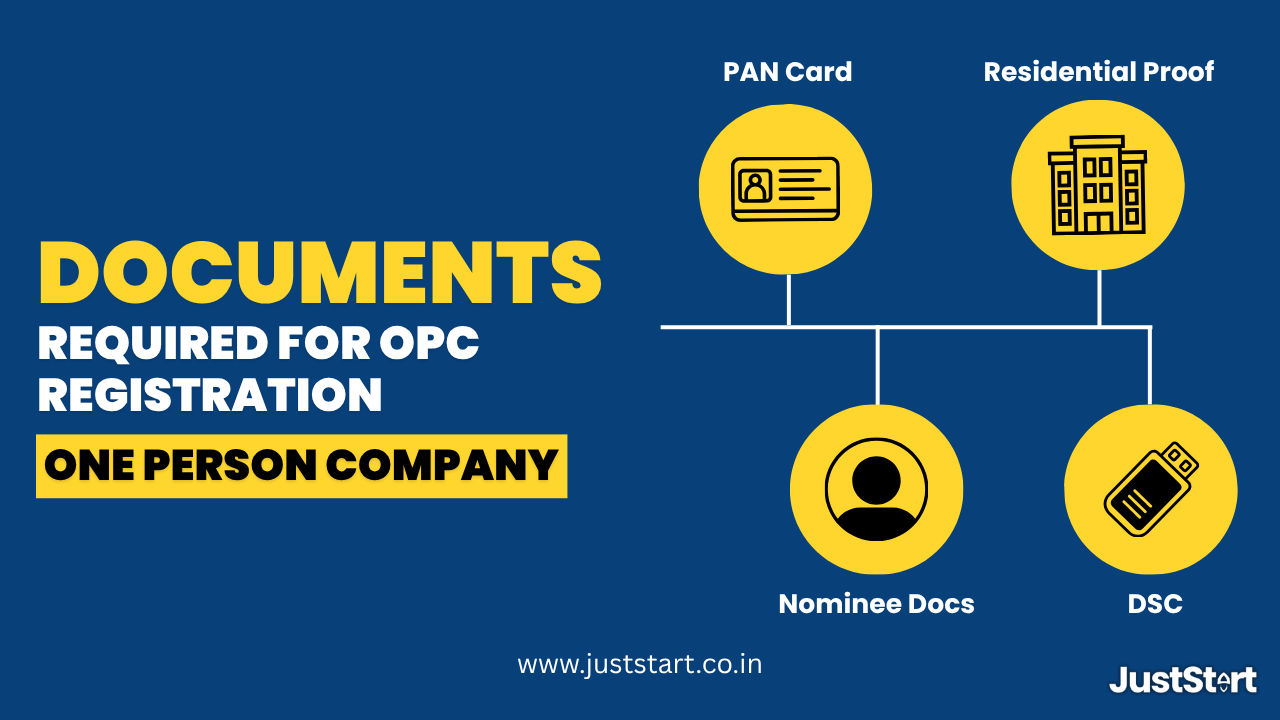
The OPC registration process is completely online and done via the Ministry of Corporate Affairs (MCA) V3 portal. SPICe+ web-based form is used to submit the incorporation application form and other documents. PAN card, ID proof, address proof, DSC, passport-size photographs, etc are the core documents required for One Person Company registration. A minor mistake during document submission for OPC registration results in immediate application rejection.
It is important to ensure that all the papers are organized and revised according to the latest standards prior to the formal filing in the MCA V3 portal. By avoiding the common mistakes while preparing the documents, the solo owners can easily incorporate their OPC in India. Let's dive into this guide to explore which documents are required for OPC registration, how to prepare them, and the cost.
What is an OPC (One Person Company)?
One Person Company (OPC) is a well-established business structure that operates under the Companies Act, 2013. Through the OPC registration, the solo owners/directors get legal access to lawfully run and own an entity. The sole owner gets complete legal rights to make decisions for external and internal purposes. The sole owner enjoys the solo business operation with limited liability benefits. As the company is distinct from its owner, the personal assets are protected from the business debts and liabilities. However, to incorporate an OPC in India, it is mandatory to appoint a nominee. The nominated individual takes over the position of sole owner if dies or incapable to manage the company's operations.
Who Can Apply for OPC Registration?
One Person Company can be incorporated by any individual who wants to run and own a company. To be eligible, it is important to be an Indian citizen and 18 years of age or above. Non-residents can also apply as long as they spend a minimum of 120 days in India during the fiscal year before submission (but foreigners cannot be accepted).
Furthermore, only a natural person can be the sole owner of an OPC, as legal entities, LLPs, and corporations are restricted from forming this business structure.
What Are the OPC Registration Documents?
Whether an OPC is incorporated by an Indian citizen or an NRI (Non-Resident Indian), the required documents are almost similar. These are the core documents you are required to attach in the web-based incorporation SPICe+ form.
1. Director and Shareholder documents (KYC Documents)
- PAN Card: Permanent Account Number (PAN) card is the primary and mandatory document for the applicant. It is used by the MCA to cross-check details for identity and tax reference.
- Government ID: Along with the PAN card, providing a copy of Aadhaar card, passport, voter ID, or driving license is also crucial.
- Address Proof: A recent bank statement or utility bill (electricity bill, water bill, telephone or post-paid phone bill). Must be in the director’s name showing his/her residential address and not be more than 2 months old.
- Photographs: Director’s passport-size photograph with a white background and must be clear.
- DSC (Digital Signature Certificate): DSC is required for electronic signing of the application. Only Class 3 DSC is valid for any MCA submission.
- DIN (Director Identification Number): If not have one already, the director can apply in the SPICe+ Part B during the incorporation process.
Note: In an OPC, the role of director and shareholder is served by only one person. A minor mistake in the solo applicant’s name or DOB results in application rejection or delay.
2. Nominee Documents
The law mandates that appointing a nominee is legally mandatory during OPC incorporation. The nominee must be an Indian citizen and resident including not be a minor (above 18 years old). A nominee in an OPC can be any individual, spouse, parent, sibling, close relative, or trusted business associate. The documents required include:
- PAN Card: Mandatory to verify the identity and tax history
- Government ID: An additional identity proof can be an Aadhaar card, voter ID, driving license, or passport.
- Address Proof: Provide a bank statement or utility bill (must not be older than 2 months)
- Photographs: Recent, clear, and scanned photographs
- Form INC-3: Written nominee’s consent filed through the form INC-3 during incorporation.
Important Reminder: PAN/Aadhaar information on INC-3 must strictly correspond to KYC docs.
3. Registered Office Address Documents
The registered office address documents depend on the property type, whether it is owned or rented. The registered office address documents checklist follows as:
If the Property is Owned
To provide the premises ownership proof, the sale deed or property tax receipt in the name of the owner is required. Otherwise, can provide the utility bill (electricity, water, or landline bill). The utility bill must not be older than 2 months.
If Property Rented
Rent/lease agreement from the property owner, including No Objection Certificate (NOC) from the landlord allowing use of the property for business purposes. For utility bills, can provide the electricity, water, landline, or telephone bill.
If Property is Family Owned
Same documents as required for rented property. NOC (No Objection Certificate) is required from the family member who owns the property. However, it is not mandatory to provide the rent agreement if no cost is invested for arrangements.
Note: The mobile post-paid bill is only acceptable for director/ nominee’s personal address proof, but can’t be used for the registered office address.
4. Statutory & Legal Documents
Beyond address and ID proofs, an OPC is required to draft legally sound documents that define the company’s internal rules, purpose, and format declarations. These core statutory and legal documents include:
- MOA (Memorandum of Association): For an OPC (One Person Company), the MOA acts as a foundational charter. It defines the OPC’s external rules and regulations, including its objectives, how it works, its relation with external stakeholders, and establishes legal identity. It must be drafted online by using the Form INC-33.
- AOA (Association of Articles): AOA must be filed electronically by using the Form INC-34. It outlines the internal rules, like how the company’s operations are managed, how director use their powers, and nominee-related procedures.
- DIR-2 Filing (Director’s Consent): The director of the OPC must write the consent to serve as the company’s director. The written consent must be filed through the DIR-2 form, which declares that you are not restricted under the Companies Act.
- INC-9 (Director’s Declarations): A self-declaration by the director/ subscriber defining that they did not commit any offence and that the details they provided are true and best of their knowledge.
- Professional Certification: A professional CA, CS, or Cost and Management Accountant (CMA) must verify that all compliances are fully met with the laws. Professional certification is a compulsory part of the SPICe+ filing.
Common Mistakes to Avoid When Preparing for OPC Documents
A minor mistake in documents related to the director’s name or nominee’s DOB results in application rejection or delay. The major mistakes you may face include:
Mistake 1: Mismatch Name/DOB
The MCA will reject the OPC registration application if details (name or DOB) mismatch across government IDs like PAN card, Aadhaar card, passport, or driving license. To avoid rejection must ensure that the documents you submitted are correct and that the details are identical to all IDs.
Mistake 2: Expired Utility Bill (Older than 2 Months)
For the registered office address proof, the utility bill (electricity or water) is the primary document. The MCA portal rejects the application if the utility bill is not older than 2 months (like 3 or 4 months old). Must ensure that the document you provided is not older than 2 months and properly mentions the address.
Mistake 3: Missing NOC (No Objection Certificate)
Providing the NOC (No Objection Certificate) is mandatory. If the property is rented and you fail to attach the NOC with other documents, it triggers an MCA remark. The registration process is delayed until the NOC is submitted, as it is required to ensure that the landlord has no issue with the OPC’s operations. Must get the no-objection certificate from the property owner.
Mistake 4: Missing DSC (Digital Signature Certificate)
You cannot apply for the OPC registration if your DSC is expired, missing, or misplaced. Only Class 3 DSC is applicable for SPICe+ filing. Before application filing, must ensure that your Class 3 DSC is not expired. If it is obtained a new Digital Signature Certificate from a licensed certifying authority.
Mistake 5: Using a Mobile Bill as Office Proof
Using the mobile bill for the official registered office is not applicable on the MCA portal. Must avoid using it as the registered office proof. But this document can be used as residential proof of the director.
Conclusion
The right and up-to-date documents for the OPC registration are the foundational gateway for a faster process. It generally takes 10-15 working days for OPC processing; however, the timeline is often delayed due to inaccuracies and incompleteness of papers. On-time submission of identity and address proof, registered office documents, consent and declaration forms is the right approach for faster OPC incorporation.
To align with MCA's guidelines and avoid application rejection, Juststart helps to verify the OPC registration documents. Our professional and dedicated experts ensure that all documents required for OPC registration are correct and fulfil the MCA's formalities.
Got a Doubt? Clear With Frequently Asked Questions (FAQs)
Q1. Is appointing a nominee mandatory for OPC registration?
Ans. Yes, appointing a nominee is legally mandatory for OPC registration. Details of the nominee are required to be submitted, such as its consent written through the Form INC-3.
Q2. When is it mandatory to convert an OPC into a private limited company?
Ans. Under the Companies (Incorporation) Second Amendment Rules, 2021, an OPC can grow without any size limitations. It is no longer mandatory to convert an OPC into a private limited company, as before the amendment, the conversion was legally mandatory when the annual turnover crossed ₹2 crore, or paid-up capital exceeded ₹50 lakhs.
Q3. Is DSC mandatory for OPC registration?
Ans. Yes, the director and nominee are required to obtain the Class 3 DSC (Digital Signature Certificate) because it is used to sign the incorporation form (usually SPICe+) on the MCA portal.
Q4. Do OPC documents need notarization?
Ans. If indian applicant is applying for OPC registration, the notarization for the incorporation documents like MOA, AOA, or identity/ address proof is not compulsory. Self-tested documents with the application form are sufficient. However, document notarization is required if an OPC is applied for by a foreign national or NRI in India.
Q5. How much does it cost to register an OPC in India?
Ans. The general cost for OPC registration ranges from ₹5,000 to ₹15,000. If you hire a professional for the services, the cost might range between ₹10,000 and ₹25,000. The exact cost depends on the professional consultancy charges and documents required for an OPC, including authorized capital up to ₹15 lakh.
Q6. Is PAN mandatory during OPC incorporation in India?
Ans. Yes, strictly legally mandatory to use a PAN card during OPC registration in India. It is required for both the director of the one-person company and the nominee.
Q7. Is an audit compulsory for an OPC?
Ans. Yes, it is a legal requirement for OPCs (One Person Companies) to submit statutory audit reports to the Registrar of Companies (ROC), regardless of revenue or turnover.
Q8. Can I use an Aadhaar card over a PAN card for OPC registration?
Ans. No, a PAN card is the mandatory and primary document required of both the director and the shareholders during the incorporation process. You cannot replace PAN with Aadhaar. PAN is required for identity proof and to know Tax status. At the same time, Aadhaar is used for identity verification.
Q9. Can a foreign national or NRI register an OPC in India?
Ans. Yes, but the MCA has strict guidelines for foreign citizens and NRIs. They can only register an OPC in India if they hold a valid Indian passport, they are not eligible for OPC incorporation. Meanwhile, an NRI with an Indian passport can register for an OPC when they stay in India for at least 120 days.
Q10. What should I do if my OPC application gets rejected on the MCA V3 portal?
Ans. The MCA often rejects the application due to incomplete or inaccurate details. You are asked to resubmit the application or correct the remark within the prescribed timeline. First, review the rejection remark, find the error, address the issue, and submit on the MCA portal via SPICe+ form Part A or Part B as required.