

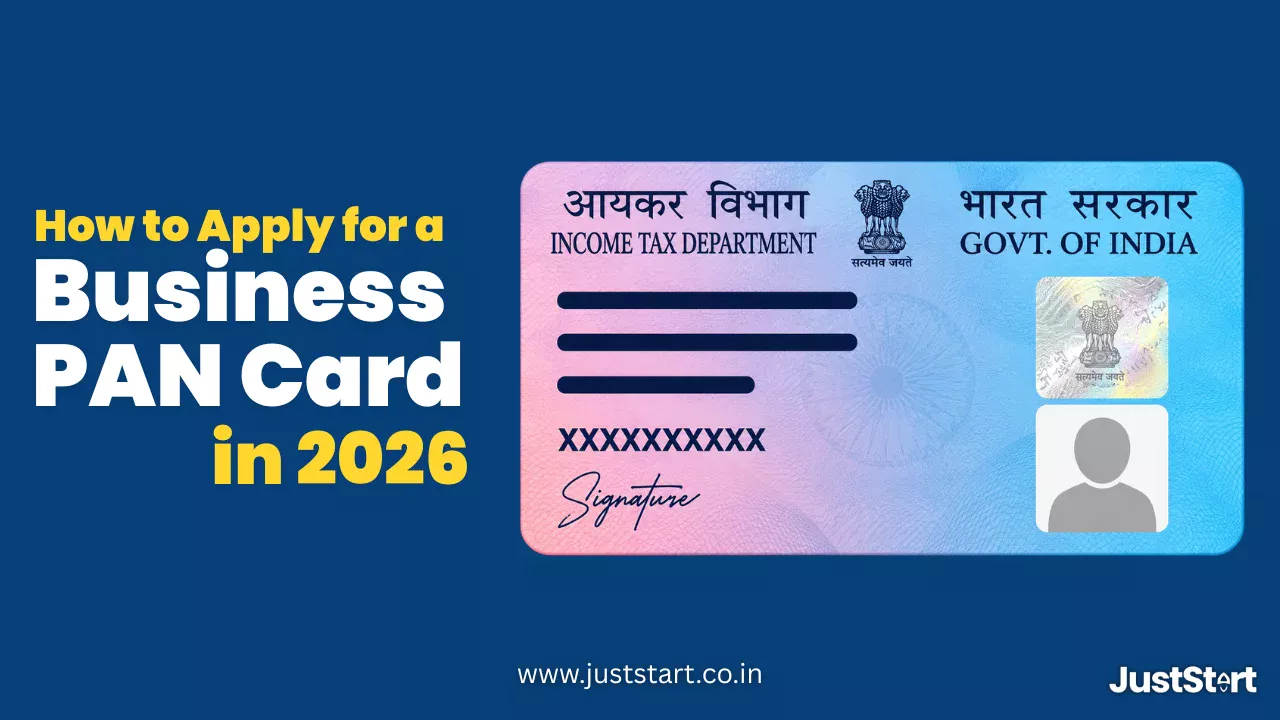
Introduction
A business PAN card is completely different from a personal PAN card. A business PAN card is issued in the name of the entity which registered under specific structure. Both companies and LLPs need to have a valid PAN card, which is used for business taxation. In India, it is allotted by the Income Tax Department, and the MCA's SPICe+ form (for companies) and FiLLiP form (for LLPs) carry the request during incorporation. However, you cannot apply for it before the incorporation process, because a company doesn't legally exist until it obtains the Certificate of Incorporation issued by the RoC.
From 1 April, 2026, Indian entities and domestic companies are required to use Form 94. Let's dive into this comprehensive guide to explore the process to obtain the corporate PAN card, the documents required, and its cost.
What is a Business PAN Card?
A company PAN Card is a 10-digit alphanumeric code that is issued by the Indian Tax Department to local entities and domestic companies, rather than a specific individual. The entities use the PAN card for tax and compliance purposes. However, having more than one PAN for the same entity and the same name can attract a penalty of ₹10,000.
The structure of a corporate PAN card is as follows:
|
|
|
|
|
|
|
|
|
|
|
|
|
|
|
|
|
|
|
|
|
|
|
|
For Example, Delta Tech Private Limited Company's PAN might look like BPWCD8841K. Here, "BPW" is a random alphabetic series, "C" stands for company, "D" is the first letter of Delta Tech, 8841 is the sequential number, and "K" is the check digit, a computer-generated security check for verification.
What Are the Benefits of a Business PAN Card?
A Business PAN (Permanent Account Number) is a 10-digit alphanumeric code, issued by the Indian Tax Department to corporate and commercial entities. The key benefits associated with a PAN card are:
- Use to Open a Current Account: A corporate PAN card is mandatory and required during the opening of a current bank account.
- Important for Income Tax Filing: A PAN card is strictly used during the filing of an Income Tax Return (ITR), because it links all statutory details to the entity directly.
- GST Registration: As the GSTIN generation process is directly tied to the business PAN, it is required during the GST registration.
- Financial Transparency: A corporate PAN separates personal finances and tax liabilities from the corporate business operations.
- Handle High-Value Transactions: Essential for executing major commercial transactions, selling or buying immovable property, or handling larger investments.
Who Needs a Company PAN Card in India?
A business PAN card applies to all entities registered with the RoC through the MCA portal. These are the entities and LLPs that are required to obtain a separate corporate PAN:
- Private or public limited company, OPC: Companies like private limited, public limited, and OPC (One Person Company) get a separate PAN along with TAN and Certificate of Incorporation after incorporation.
- LLP (Limited Liability Partnership): A Limited Liability Partnership is separate from its owner; therefore, it is also required to obtain a separate business PAN card.
- Partnership Firm: Partnership Firms in India use Form 94 to apply for a PAN Card online via Protean or UTIITSL.
- Non-Corporate Organizations: Trusts, societies, AOPs, and BOIs are also treated as a separate "person" under the Income-tax Act and need to obtain a separate PAN card.
- HUF: Hindu Undivided Family (HUF) also holds a separate PAN card, applied for by the Karta.
- Foreign Individuals: Foreign individuals can apply for a PAN card by using Form 95.
- Foreign Entities: Foreign entities operating in India can also apply for a separate PAN card by using Form 96.
Who Doesn't Need a Separate PAN Card?
A "Sole Proprietorship" doesn't require a separate PAN card for business. This is because it is not a separate legal entity as per Indian corporate law. Therefore, the Income Tax Act restricts sole proprietorships from holding more than one PAN. At this stage, the owner uses their personal PAN card to fulfil compliance.
2026 Updates Related to PAN Card
Since April 1, 2026, multiple changes have been made to the individual PAN card and corporate PAN Card. These updates strictly apply to fresh applications and requests for correction. The serving authority replaced all old forms used for PAN cards with new ones to minimize errors and make much better categorize applicants. Here is the complete checklist made for the application form:
- Form 93: This application form replaced the old Form 49A. Form 93 is strictly applicable for Indian individual citizens. Aadhaar is mandatory for Indian citizens applying with Form 93, and from April 1, 2026, it is no longer accepted as proof of Date of Birth.
- Form 94: Specially designed for Indian non-individual entities such as companies, LLPs, firms, trusts, HUFs, BOIs and AOPs. It replaces the entity use of Form 49A.
- Form 95: This form replaced Form 49AA, designed for foreign individuals.
- Form 96: Foreign entities registered in India must use Form 96 for a corporate PAN card. It replaces the entity use of Form 49AA.
Use the Protean PAN Services Portal to apply for a corporate PAN card or track the application.
How to Apply for a Business PAN Card?
A business PAN card online is issued through the MCA SPICe+ form along with TAN and Certificate of Incorporation. However, if any legally existing company applies independently for PAN, then the process is as follows:
Step 1: Navigate the Portal
If the automated process does not apply or a company/LLP wants to update the PAN details, then visit the "Protean eGov PAN Portal" or "UTIITSL Portal".
Step 2: Choose Application Type
Choose the right PAN card application form according to your background. If applying as an Indian individual, choose Form 93; if you are a corporate entity (LLPs, HUFs, trusts), choose Form 94.
Step 3: Select Entity Category
Choose the business structure under which you registered, such as a private limited company, LLP, or Trust. Usually, standard companies get the PAN during the incorporation process with TAN.
Step 4: Fill Business Details
Mention your entity name, business incorporation date, official contact, business address, and email ID.
Step 5: Authorised Signatory or Director Details
The application for a PAN card can only be filled by the authorized signatory or director of the company. As per the requirements, mention the details of the authorized signatory or director.
Step 6: Upload Documents & Pay Fees
Provide all statutory and operational documents. The type of documents depends on which business structure you registered. For example, a Partnership Firm. Pay the filing fees online via any payment gateway. The fee for a Business PAN card is ₹107 for Indian addresses.
Step 7: Verify and Submit
Double-check all details. Submit the application and save the 15-digit acknowledgement number. It helps you track the application process.
Documents Required for a Business PAN Card
The documents required for a corporate PAN card depend entirely on the specific business structure. Here is the complete checklist of documents to apply for a business PAN card:
Company
If your entity is registered as a Private Limited, Public Limited or OPC, then provide the Certificate of Incorporation issued by the Registrar of Companies (RoC); authorising board resolution; identity and address proof of the authorised signatory, etc.
Partnership Firm
If your entity is registered as a Partnership Firm, then provide documents like the Partnership deed or Registrar of Firms registration certificate; identity and address proof of partners; address proof of the firm
LLP (Limited Liability Partnership)
A registered LLP is required to provide the Certificate of Incorporation or registration from the Registrar of LLPs; LLP agreement; partners' resolution authorising the applicant; identity and address proof of designated partners.
Trust
Must provide the Trust deed; registration certificate from the Charity Commissioner; trustees' identity and address proof and authorising resolution. All documents must be accurate.
HUFs
Hindu Undivided Families are also eligible to apply for a separate PAN card. The documents generally required belong to the Karta's Identity and address proof and an affidavit from the Karta.
AOP or BOI
Agreement, if any; entity address proof; members' identity and address proof; authorising resolution.
Business PAN Card Fees and How Long It Takes
The cost for the corporate PAN card depends on how you are applying: electronically or offline. Corporate PAN card fees differ as follows:
|
|
|
|
|
|
|
|
|
|
|
|
|
|
|
|
|
|
|
|
|
Timeline for Corporate PAN Card Issuance
e-PAN arrives faster compared to the physical PAN card. If the documents submitted by you are correct and the details match the existing sources, then the process will be much faster. However, if any query related to rejection is raised, then the timeline can be extended by up to 10-15 working days.
Business PAN Application Rejected: Common Mistakes
Often, the PAN card application gets rejected due to poor documentation and mismatched information. The common mistakes you might face:
- Using the Old Form: Form 49A (for Indians) and Form 49AA (for foreigners) are not applicable. These original application forms were replaced with the new Application Form 94 (for Indian entities) and Form 96 (for foreign entities).
- Apply for PAN for Sole Proprietorship: As per law, a Sole Proprietorship and the owner are the same. There is no legal distinction; a personal PAN card is enough. The portal rejects the application if you are applying for a sole proprietorship.
- Applying Again After Incorporation: The portal will not accept the application for a corporate PAN Card, if your LLP or company already received it after incorporation along with CIN (Certificate of Incorporation).
- Selected Wrong Entity Type: You mentioned the wrong structure of your company during the corporate PAN card filing process.
- Mismatch Details: Details mentioned in the application form do not match the existing documents, such as name, address proof, incorporation date, and address.
- Not Authorised or a Director: Only an authorized signatory or a director can apply for a corporate PAN for any legal entity. If neither of them is available, you cannot apply for a separate PAN.
Conclusion
A valid 10-digit alphanumeric PAN card streamlines tax filings, banking operations, and regulatory compliance. A corporate entity cannot mix its tax liabilities with a personal bank account. During the current bank account opening process for companies or LLPs, a PAN card is mandatorily used to fetch the financial details. Got any doubts? Consult JustStart experts and make your journey to open the bank account easier and faster.
Frequently Asked Questions (FAQs)
Q1. What is a business PAN card?
Ans. A business PAN card is a 10-character alphanumeric code, issued by the Income Tax Department in the legal name of the entity. It is required to separate the personal PAN of owners from the corporate PAN for tax, GST, and banking purposes.
Q2. Can a sole proprietorship get a separate business PAN?
Ans. No, a sole proprietorship is not a separate legal entity; the proprietor uses their personal PAN card for tax and other purposes.
Q3. Which form is used to apply for a business PAN in 2026?
Ans. After the updates effective from April 1, 2026, non-individual Indian entities must use Form 94 (replacing Form 49A) for a corporate PAN card. Whereas foreign entities registered in India must use Form 96. The existing PAN remains valid, and there is no need for replacement.
Q4. Are companies and LLPs required to apply for a PAN card separately?
Ans. Usually not. PAN and TAN are issued along with the certificate of Incorporation when a company files SPICe+ or an LLP files FiLLiP with the MCA.
Q5. Who can apply for corporate PAN on behalf of an entity?
Ans. Only a director or an authorised signatory can apply for a company's PAN. Therefore, keeping both personal information and company information ready in advance is crucial before starting the process.