

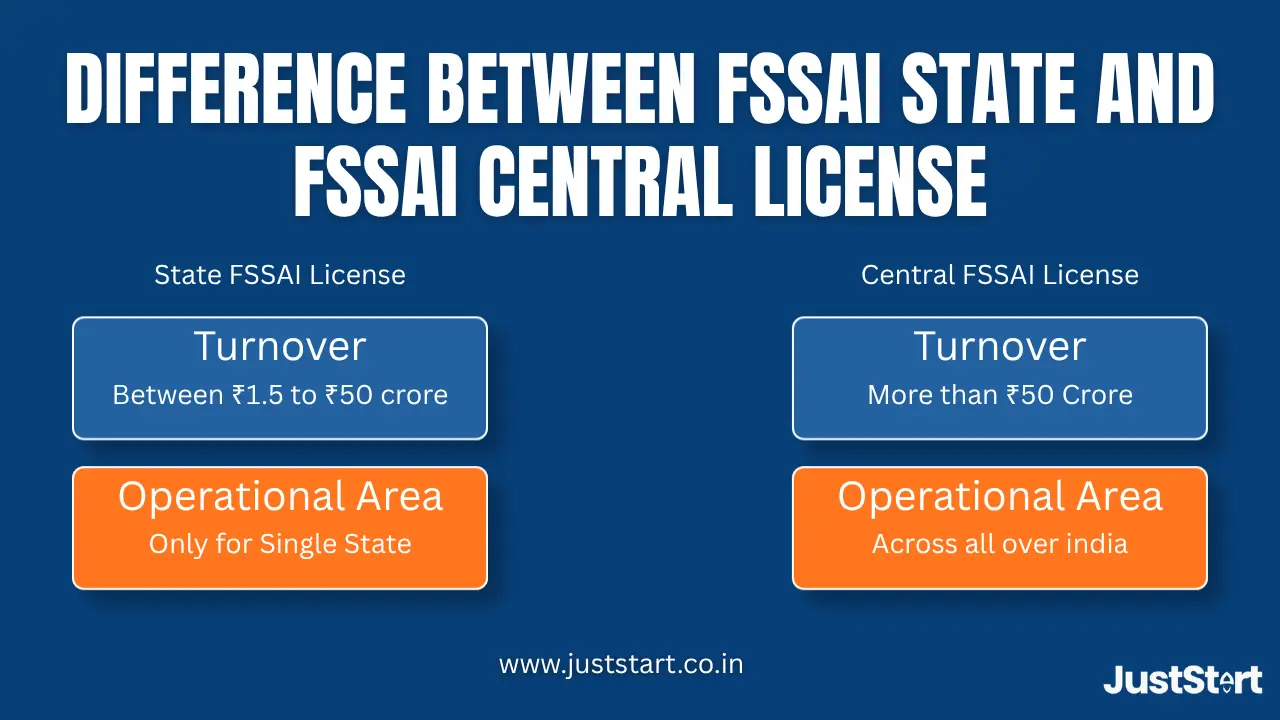
The FSSAI license requirement will be the first obstacle you face when you start your food business in India. The registration process will start, but the common question people have is which FSSAI license they should obtain between the State License and Central License.
Choosing the wrong option creates problems which result in both compliance difficulties and extra financial expenses. The guide explains all essential information about FSSAI State License and Central License requirements through clear language, which helps you choose the best option for your business.
What is FSSAI and Why Does It Matter?
The Food Safety and Standards Authority of India (FSSAI) serves as the main authority which controls and monitors food safety operations throughout India. FSSAI, which operates according to the Food Safety and Standards Act of 2006, establishes hygiene standards and quality requirements that food products must meet before reaching consumers.
All food business operators (FBO) throughout India must secure their FSSAI license or registration before they begin their business activities, which include home kitchens and restaurant chains and commercial food processing plants. The law considers business operations without one to be a criminal offence, which results in financial penalties and business shutdowns.
FSSAI has a three-tier licensing system:
1. FSSAI Basic Registration- for very small or petty food businesses.
2. FSSAI State License- for mid-scale food businesses operating within one state.
3. FSSAI Central License- for large-scale businesses or those operating across multiple states.
The article explains how food businesses choose between Central FSSAI licenses and State FSSAI licenses as their main decision point.
What is FSSAI State License?
The FSSAI State License is issued by the State Food Safety Authority, which is the Food Safety Commissioner of the respective state or union territory. The regulation applies to food business operators who limit their activities to one state while maintaining their business operations within specified annual revenue limits.
Who Needs a State License?
A State License is applicable to food businesses whose annual turnover is between ₹1.5 Crore and ₹50 crore. This category includes all of the following items:
- Restaurants, dhabas, and food courts with moderate revenue
- Mid-sized food manufacturers and processors
- Retailers, distributors, and wholesalers operating locally
- Hotels with limited star ratings (below 5-star)
- Small to medium-scale caterers
- Storage units and cold storage facilities below a specified capacity
- Re-packers and re-labelers operating within one state
You need a State License which matches your eligibility because your business activities stay within one state and your yearly revenue does not go beyond ₹50 crore.
Key Features of FSSAI State License
- Issuing Authority: State Food Safety Commissioner
- Validity: Depends upon the number of years you will apply for it.
- License Number Format: 14-digit number beginning with the state code
- Jurisdiction: Operations limited to a single state or UT
- Application Platform: FoSCoS (Food Safety Compliance System) portal
What is FSSAI Central License?
The FSSAI Central License gets granted through the Central Licensing Authority, which operates under FSSAI regulations. The license applies to large food businesses which operate across multiple states and maintain high revenue levels or specific business operations that require central government control.
Who Needs a Central License?
A Central License is mandatory when:
- Your annual turnover exceeds ₹50 crore
- Your business operates across more than one state (importers, exporters, multi-state manufacturers, or distributors)
- You are engaged in import or export of food products
- You run a 100% Export Oriented Unit (EOU)
- You operate a Central/State Government canteen or a department canteen
- Your business involves food manufacturing or processing in a Special Economic Zone (SEZ)
- You own a 5-star or above hotel
- You are operating a large dairy or dairy processing plant with a defined milk handling capacity
- You run a slaughterhouse with a defined throughput
The Central License becomes mandatory for your business when it operates across state borders or handles extremely large quantities of goods.
Key Features of FSSAI Central License
- Issuing Authority: Food Safety and Standards Authority of India (Central)
- Validity: depends upon the number of years you will apply for it.
- License Number Format: 14-digit number starting with 1 (indicating central jurisdiction)
- Jurisdiction: Pan-India or multi-state operations
- Application Platform: FoSCoS portal
FSSAI State License vs Central License: A Side-by-Side Comparison
You can compare central and state FSSAI licences through specific parameters, which make their differences easier to understand.
|
|
|
|
|
|
|
|
|
|
|
|
|
|
|
|
|
|
|
|
|
|
|
|
|
|
|
|
|
|
|
|
|
|
|
|
|
|
|
|
How to Decide Which License Your Business Needs
Choosing between FSSAI Central vs State License depends on three primary factors:
1. Annual Turnover
This is the simplest filter. If your food business earns:
- Less than ₹1.5 Crore annually → Go for FSSAI Basic Registration
- Between ₹1.5 Crore and ₹50 crore → Apply for FSSAI State License
- Above ₹20 crore → You must apply for FSSAI Central License
2. Geographic Reach
A company needs a Central License when it operates across multiple states, despite its revenue being less than ₹50 crore. Your business location exists in one state, yet your activities extend into other states.
3. Nature of Business
All food businesses must obtain central authority approval, which applies to all businesses regardless of their income and location. All importers and exporters must secure a Central License according to regulations. All 5-star hotels and large dairy operations and food businesses located in SEZs must obtain central licenses, which apply to them even though their total revenue does not meet the standard licensing threshold.
Application Process: State vs Central
Both licenses are applied for through the FoSCoS (Food Safety Compliance System) portal at foscos.fssai.gov.in. The documentation requirements are broadly similar, but they differ according to the specific business category.
Common Documents Required
- Proof of identity and address of the proprietor/partners/directors
- Passport-size photographs
- Business constitution proof (Partnership Deed, Certificate of Incorporation, etc.)
- Proof of premises ownership or rental agreement
- List of food products to be manufactured or dealt in
- Food Safety Management System (FSMS) plan
- Source of raw material declaration (for manufacturers)
- NOC from the local municipal body or panchayat (in some states)
Central License applications need extra documents, which depend on the specific category of the application, because importers and exporters need an import-export code (IEC) and export-oriented units need an EOU certification.
Processing Time
- State License: Typically processed within 30 to 60 working days of complete application submission.
- Central License: May take 30 to 60 working days, depending on inspection and verification requirements.
Common Mistakes to Avoid During FSSAI Registration
Food business operators who apply for FSSAI licenses make expensive mistakes, which lead to negative results. Here are a few to watch out for:
Applying for the wrong Category: If you underestimate your turnover or scope and apply for a State License when you need a Central one, you could face compliance penalties. Your actual annual turnover needs to be accurately reported at all times.
Ignoring Multi-state Operations: Central License requirements apply when a single supply chain operation crosses state boundaries. This requirement is commonly overlooked by small manufacturing businesses.
Delaying Renewal: FSSAI licenses must be renewed before they expire. Operating with an expired license is treated the same as operating without a license.
Incomplete Documentation: Incomplete applications are rejected or put on hold, causing significant delays. All documents must be complete before submission to the office.
Penalties for Non-Compliance
The FSSAI treats non-compliance violations as serious matters. Businesses that operate without registration or license face minimum penalties of ₹1 lakh, which increase to criminal prosecution for adulteration or unsafe food practices. Businesses that operate beyond their licensed capacity face significant financial penalties.
The process of obtaining the appropriate license at the beginning establishes a genuine base which supports both the legal and operational integrity of your business.
Can You Upgrade from State to Central License?
The situation allows you to proceed with the task, and you should do so in most situations. The law requires you to upgrade from a State License to a Central License when your business reaches a ₹50 crore turnover, or you expand your business operations to multiple states. The process requires you to submit a new Central License application through the FoSCoS portal. The Central License will be issued after you surrender your existing State License.
The best approach for this transition requires you to create advanced plans that should be completed before your current license reaches expiration.
Conclusion: Which FSSAI License is Right for You?
The FSSAI Central vs State License decision can be explained through two main points-
- The FSSAI State License applies to small to mid-scale food businesses that operate in one state and generate between ₹1.5 crore and ₹50 crore in revenue.
- The FSSAI Central License applies to businesses that operate at large scale or handle international trade, conduct business in multiple states or generate more than ₹50 crore in revenue.
The correct license selection enables your business to maintain legal compliance while establishing trust with customers, distributors and retailers who seek partners that meet FSSAI standards.
A business owner should consult an expert in FSSAI compliance when they face uncertainty about their business classification or when their business operations include multiple verticals, joint ventures, and hybrid supply chains.
JustStart offers assistance with your FSSAI registration application process by guiding you through the correct license selection and application submission and authority follow-up procedures. Our team stands ready to help you establish your food business correctly through our services.
FAQs (Frequently Asked Questions)
Q1. What is the main difference between FSSAI State License and Central License?
The most significant distinction between the two things exists because of their different dimensions. A State License covers food businesses that operate within a state and generate annual revenue up to ₹50 crore. The Central License applies to businesses that operate across state boundaries, handle imported and exported goods and generate yearly revenues above ₹50 crore.
Q2. Which FSSAI license do I need for my restaurant?
Most restaurants fall under the State License category, as long as their operations stay within one state and their yearly revenue remains below ₹50 crore. Central License requirements apply only to 5-star hotels, which operate as restaurant-type establishments.
Q3. Does a small food business need FSSAI registration at all?
Every food business in India must obtain either FSSAI Basic Registration, a State License or a Central License according to regulations that apply to all food establishments regardless of their size. The operation of a food business without proper licensing constitutes a legal violation which results in severe monetary penalties or business closure.
Q4. How much does it cost to get an FSSAI State License vs Central License?
A State License typically costs between ₹2,000 and ₹5,000, depending on your state and business type. A Central License costs ₹7,500 for most business categories. These government fees exclude all charges for professional services.
Q5. Can I get a Central License even if my turnover is below ₹50 crore?
Yes, Turnover is not the only deciding factor. Businesses that import or export food products must obtain a Central License, which applies to operations in multiple states and special economic zones and to specific business types, which include large dairies and slaughterhouses.
Q6. How long does it take to get an FSSAI license approved?
A State License is usually approved within 30 to 60 working days after you submit a complete application. A Central License requires additional time for its processing, which takes between 30 and 60 working days because inspectors need to conduct their verification procedures.