

Are you unsure which business structure will best support your growth and significantly affect how much tax you pay? Worry no more, as you have come to the right place. With this article, you will make an informed decision about the right business structure for startups in India.
The first step in the business registration process is to choose the right business structure.
Understanding the Importance of Choosing the Right Business Structure
The process of selecting the right legal structure for your small business in India is much tougher than what appears at first sight. The reason being that the legal structure used will not only have a direct impact on the taxes to be levied but also the kind of decisions you will be making, the growth of the company, investments rendered, and more.
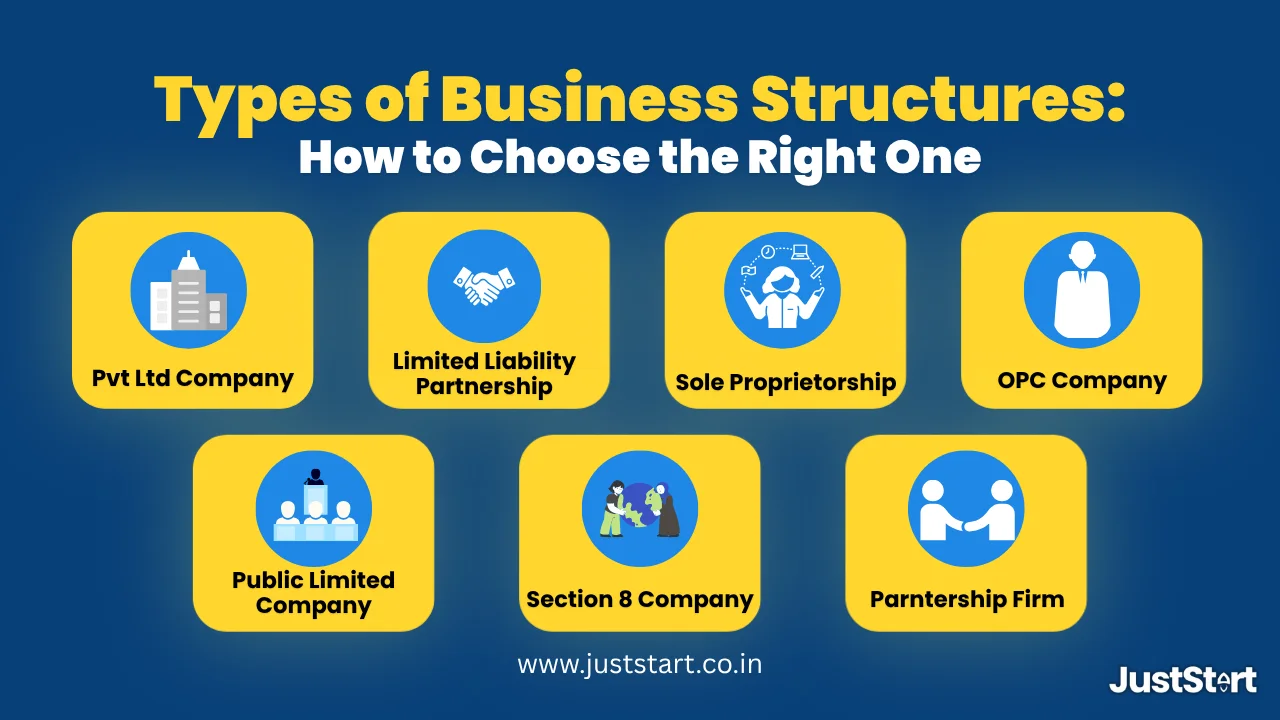
There are three main business structures in India:
- Private Limited Company
- Limited Liability Partnership (LLP)
- Sole Proprietorship
- One Person Company (OPC)
- Partnership Firm
- Section 8 Company
- Public Limited
You can also hire a legal advisor or an expert to select the best business structure for startups.
Why Your Business Structure Matters for Growth and Compliance?
The business structure type in India that you choose matters a lot for your company’s growth. The registration process of your startup also depends on the structure you choose. Before moving on with Pvt Ltd vs LLP and OPC vs Sole Proprietorship, let’s check the importance of choosing the right structure:
- There is a different tax structure for different business structure types in India. So, it also affects business compliance and tax obligations.
- The startup registration checklist is different for all structures. Knowing this will help to ensure a smooth Pvt Ltd Company Registration process and Sole Proprietorship registration in India.
- The best business structure for startups also helps to attract investors and get funds for your company.
- Choosing the correct business structure will also help in your company’s growth.
Key Factors to Consider When Selecting a Business Entity
There are certain key factors that will help in the Pvt Ltd vs LLP vs Sole Proprietorship vs OPC comparison:
- Size of business- If you are going to start a large company, then you should opt for a Private Limited company or LLP.
- Number of owners- For single owners, you must go for a One Person Company or Sole Proprietorship and for more than two owners, LLP or Pvt Ltd is best. It helps to know the personal liabilities and other aspects.
- Taxation Process- The taxes for LLP and Pvt Ltd companies are calculated according to the corporate rates, whereas for a sole proprietorship, it is lower.
Overview of Different Business Structures in India
Let's know the features of the best business structures for startups, which will help you understand the process smoothly.
|
|
|
|
|
|
|
|
|
|
|
|
|
|
|
|
|
|
|
|
|
|
|
|
|
|
|
|
|
|
|
|
|
|
|
|
|
|
|
|
|
|
|
|
|
|
|
|
|
|
|
|
|
|
|
|
|
|
|
|
|
|
|
Sole Proprietorship: Features, Pros & Cons
Some key features of a Sole Proprietorship Registration are given below:
- Single Owner: Owned and operated by a single person only.
- No Separate Legal Entity: The Business and the owner are not distinct legal entities.
- Minimal Compliance: Extremely few statutory compliances or filings in relation to Pvt Ltds or LLPs.
- Unlimited Liability: The owner has unlimited personal liability for business liabilities and obligations.
- No Profit Sharing: Total profit is the property of the sole proprietor.
- Total Control: Absolute power to decide and run the business.
Let's go through the pros and cons of a sole proprietorship:
|
Pros |
Cons |
|
Easy registration process for a Sole Proprietorship. |
Easy registration process for a Sole Proprietorship. |
|
The owner has all the authority in the company's decision-making process. |
The owner has all the authority in the company's decision-making process. |
|
The cost to set up and register is less compared to all. |
The cost to set up and register is less compared to all. |
|
No major compliance is required for audits, ROC filings, and board meetings. |
Not considered a separate legal entity, which can limit credibility. |
|
Tax is lower than in other structures. |
Tax is lower than in other structures. |
Private Limited Company (Pvt Ltd): Features, Pros & Cons
Some key features of a Private Limited Company are stated below:
- Limited Liability: The Liability of shareholders is limited to the amount of their shares remaining unpaid.
- Minimum & maximum member requirements: Minimum 2 and maximum 200 members are required.
- Name Suffix: Should mandatorily have "Private Limited" or "Pvt Ltd" suffix at the end of its name.
- Scope of Funding: Able to raise capital from private investors, venture capitalists, and angel investors (but not from the public).
- Share Transfer Restriction: The shares are not transferable freely; transfer is an under restriction in the Articles of Association.
- Ownership & Control: Family members or close friends are usually the owners, which allows for more control over the business.
The Private Limited Company benefits can be easier to raise funds and attract investors. However, it can also have certain cons that you must be aware of. Below, we list the advantages and disadvantages of a private limited company.
|
Pros |
Cons |
|
Personal assets of shareholders are protected. |
It’s costly to maintain, and compliance costs are higher. |
|
The company has a separate legal identity. |
The company has a separate legal identity. |
|
Easier to raise funds and bring in investors. |
Easier to raise funds and bring investors. |
|
Regulated structure brings trust among the clients. |
It is not sufficient for small businesses. |
|
It is not sufficient for small businesses. |
The registration process can be hectic |
Limited Liability Partnership (LLP): Features, Pros & Cons
Some key features of the best business structure in India are mentioned below:
- Limited Liability: Each partner's liability is limited to the extent of his contribution.
- Minimum Partners Requirement: 2 partners as minimum; no limit on the maximum number of partners.
- Name Suffix: Should have "LLP" as a suffix to its name.
- No Requirement of Minimum Capital: No minimum capital contribution is necessary to establish a Limited Liability Partnership.
- Less Compliance: LLPs are governed by fewer statutory compliance rules than Pvt Ltd Cos.
- Sharing of Profits: Profits and losses are distributed among partners according to the LLP agreement.
The LLP Registration in India can be a bit hectic and complex. But it also comes with many advantages. Let’s check all of the LLP pros & cons:
|
Pros |
Cons |
|
Very limited personal liability of shareholders. |
Problems in raising funds for the LLP. |
|
Not suitable for big businesses |
Not suitable for big businesses |
|
Has less compliance burden. |
Has less compliance burden. |
|
Even if one of the owners leaves, the LLP continues to run. |
Even if one of the owners leaves, the LLP continues to run. |
Registration Process & Compliance Requirements
Both buildings have unique registration and compliance norms. Private Limited and Limited Liability Partnerships need MCA (Ministry of Corporate Affairs) filings, while a Sole Proprietorship will only need basic local registrations such as MSME, GST Registration, or Shop & Establishment.
Which Business Structure Is Best for Different Types of Entrepreneurs?
Depending on what type of business you want to start, your business structure can differ. So, here’s a small guide that will help you select your business structure.
- Startups: Private Limited Company
- Freelancers/Consultants: Sole Proprietorship or Limited Liability Partnership
- Small Traditional Businesses: Sole Proprietorship
- Professional Firms (CA/Lawyers): Limited Liability Partnership
- Family Businesses: Limited Liability Partnership or Private Limited Company
Best Business Structure for Startups & High-Growth Companies
Startups looking to grow quickly, raise funds, and scale up must choose Pvt Ltd because of legal legitimacy, investor attractiveness, and structural advantages.
Liability Protection: Which Structure Offers Better Security?
To protect your personal assets, you must go for a Limited Liability Partnership (LLP). In any case, only your company’s share will be at stake.
Steps to Register Your Business Structure in India (2026)
For easier understanding and implementation, we state below all the steps involved in registering your desired business structure in India in a sequential order.
How to Register a Private Limited Company (Pvt Ltd)?
- Select a business name and verify availability.
- Then, you have to apply for a Digital Signature Certificate (DSC).
- Register for a Director Identification Number (DIN) or Designated Partner ID (DPID).
- File incorporation papers with MCA (for Pvt Ltd/LLP)
- Apply for PAN (Permanent Account Number), TAN (Tax Deduction and Collection Account Number), GST (Goods and Services Tax) and MSME (Ministry of Micro, Small and Medium Enterprises).
How to Register a Limited Liability Partnership (LLP)?
- Obtain a Digital Signature Certificate (DSC) and a Designated Partner Identification Number (DPIN).
- Name reservation under Limited Liability Partnership-RUN (Reserve Unique Name).
- File the incorporation form FiLLiP.
- Draft and file the Limited Liability Partnership Agreement.
- Also, apply for PAN (Permanent Account Number), TAN (Tax Deduction and Collection Account Number), GST (Goods and Services Tax), etc.
How to Set Up a Sole Proprietorship in India?
- Select the name of the business.
- Register under the Shop & Establishment Act.
- Apply for a PAN (Permanent Account Number) and open a bank account.
- Then you have to register for GST (Goods and Services Tax) and MSME (Ministry of Micro, Small and Medium Enterprises) if required
Common Mistakes to Avoid When Choosing a Business Structure
When choosing the best business structure for startups, entrepreneurs also make some unnecessary but influential errors that may put time and money at risk as well as jeopardise future growth prospects. It is possible to make a more strategic and informed choice by knowing these parameters.
Ignoring Future Business Expansion Plans
One of the biggest entrepreneurial mistakes is not to include planning in a way to accommodate their growth over time. Beginning with a structure that isn't scale-capable can limit your opportunities, cause operational obstacles and finally result in an expensive reorganisation.
It’s essential to select a business structure that not only meets current needs but also helps to bring funds and growth for the company.
Overlooking Tax and Compliance Costs
While initialising a new business, many entrepreneurs focus only on initial setup costs while ignoring the long-term tax requirements to be faced, depending on their business structures. That’s why it is very important to know the tax benefits of Pvt Ltd, LLP, and Sole Proprietorship. There are some important business compliance and tax obligations to be considered:
- Private Limited companies have higher compliance expenses due to many factors like mandatory audits, board meetings and filings with the Registrar of Companies.
- Limited Liability Partnerships have moderate compliance requirements, but failing to file annual returns can lead to penalties.
- A Sole Proprietorship may seem inexpensive at the start, but it can attract higher personal tax liability for the owner if profit increases.
Key Takeaways for Entrepreneurs & Small Business Owners
- Build a Strong Foundation: It's easier to build sustainability if you focus on documentation, clear agreements, and transparency from the start.
- Seek Expert consultancy: Consulting from legal, financial and business professionals like Juststart is highly recommended to avoid costly mistakes.
- Prioritising legal protection for the short term: If the exact formalities are not followed in business for short-term benefits, the cost would later be extravagant.
- Defining Clear Goals and Making Choices Wisely: One should have a clear understanding of the short-term and long-term business objectives, and only then opt for the right structure, strategy, or investment.
Conclusion
Business structure selection in India is not only a legal requirement, but also the very first thing that impacts compliance, taxation, growth, and funding options for your start-up. It is really important that wherever you are starting or aiming for very high expansion, you keep your structure in line with its long-term vision.
There is no reason to be in a hurry to decide or blindly go with what others are doing. Each business is different and might require a completely different structure choice that might result in serious legal consequences, tax benefits not being claimed, and future investor disinterest.
In case you are still hesitant about deciding which structure is the most appropriate for your startup, JustStart is right here to help you out. The startup, right from the beginning, will be taken care of by our team – whether it is the issue of legal counselling or full-fledged set-up support.
Frequently Asked Questions (FAQs)
Q1. Which business structure is ideal: OPC vs Pvt Ltd?
Ans. OPC (One Person Company) structure is ideal for sole founders who want complete ownership with limited liability benefits. Whereas the Pvt Ltd structure is ideal for those who wants the extranal funding to grow faster.
Q2. Can a private limited company offer its shares?
Ans. Yes, a private limited company can issue its shares, but it cannot offer the shares to the general public.
Q3. Can an OPC pay a salary to a director?
Ans. Yes, an OPC (One Person Company) can pay a salary to a director.
Q4. Who cannot register for a Section 8 company?
Ans. Section 8 company cannot be formed by minors, a One Person Company (OPC), Profit-motivated groups, or an unlimited liability structure. This is because a Section 8 company (NGO) is formed to promote art, education,
science, and social welfare.
Q5. Is it mandatory to convert an OPC into a private limited company?
Ans. No, it is no longer mandatory to convert an OPC into a private limited company based on the turnover or paid-up capital. An OPC can continue as long as it wants without conversion.